


First, Let’s Define Our Terms
Before we dive into the beautiful weirdness of Venus, let’s get two basic definitions straight. A 'year' is the time it takes for a planet to complete one full orbit around its star. For Earth, that’s approximately 365 days. A 'day' is the time it takes for a planet to complete one full rotation
on its own axis. For Earth, that’s about 24 hours. This system gives us a familiar rhythm. Our planet spins briskly on its axis while steadily journeying around the Sun, packing hundreds of sunrises and sunsets into a single orbit. We take this for granted, but the cosmos doesn't have to follow our rules. And no planet in our solar system breaks these rules more dramatically than Venus.
The Venusian Time Warp
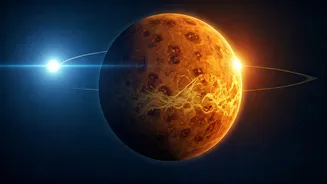
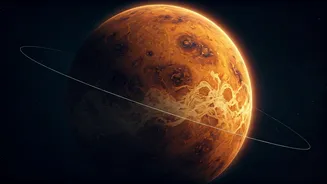
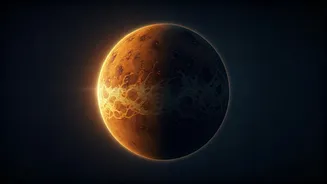
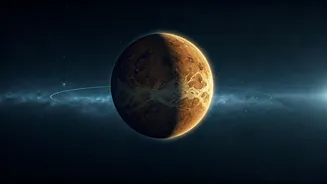
Now let’s apply these concepts to Venus. A Venusian year—the time it takes to orbit the Sun—is about 225 Earth days. So, if you were living on Venus, your 'year' would be significantly shorter than an Earth year. Simple enough. Here’s where it gets strange. A Venusian day—the time it takes for the planet to spin once on its axis—is a mind-boggling 243 Earth days. That’s right: it takes longer for Venus to complete a single rotation than it does for it to complete a full orbit around the Sun. A day on Venus is longer than a year on Venus. This makes it the slowest-rotating planet in our entire solar system.
It Gets Weirder: Backwards and Slow
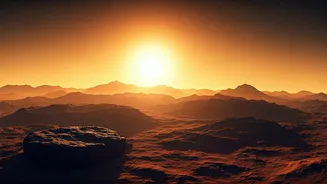
As if a day being longer than a year wasn't enough, Venus throws another curveball at us: it spins backward. This is known as retrograde rotation. Nearly every other planet in our solar system, including Earth, spins counter-clockwise on its axis. Venus spins clockwise. This means if you could stand on the surface of Venus (which you can’t, due to the crushing pressure and hellish temperatures), you would see the Sun rise in the west and set in the east. This backward spin, combined with its slow orbital speed, creates another bizarre quirk. The time from one sunrise to the next (a 'solar day') is different from the rotational period. On Venus, a solar day is about 117 Earth days. So you’d have daylight for nearly two straight months, followed by two months of darkness. It's a world of extreme temporal shifts, completely alien to our Earthly experience.
Why is Venus Like This?
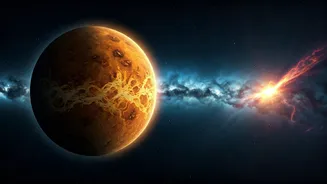
Scientists don't have a single definitive answer, but there are two leading theories. The first involves a colossal, planet-shattering impact early in Venus's history. It’s possible that billions of years ago, a massive planetoid or asteroid slammed into Venus, not only slowing its rotation to a crawl but also knocking it over so that it began spinning in the opposite direction. The second theory points to Venus's incredibly thick, heavy atmosphere. This dense blanket of carbon dioxide—90 times thicker than Earth’s atmosphere—may have created powerful atmospheric tides. Over billions of years, the friction between the churning atmosphere and the solid planet could have acted as a powerful brake, gradually slowing its spin and even reversing it. It’s a powerful reminder that a planet’s atmosphere can fundamentally shape its very mechanics.
What This Tells Us About Our Universe
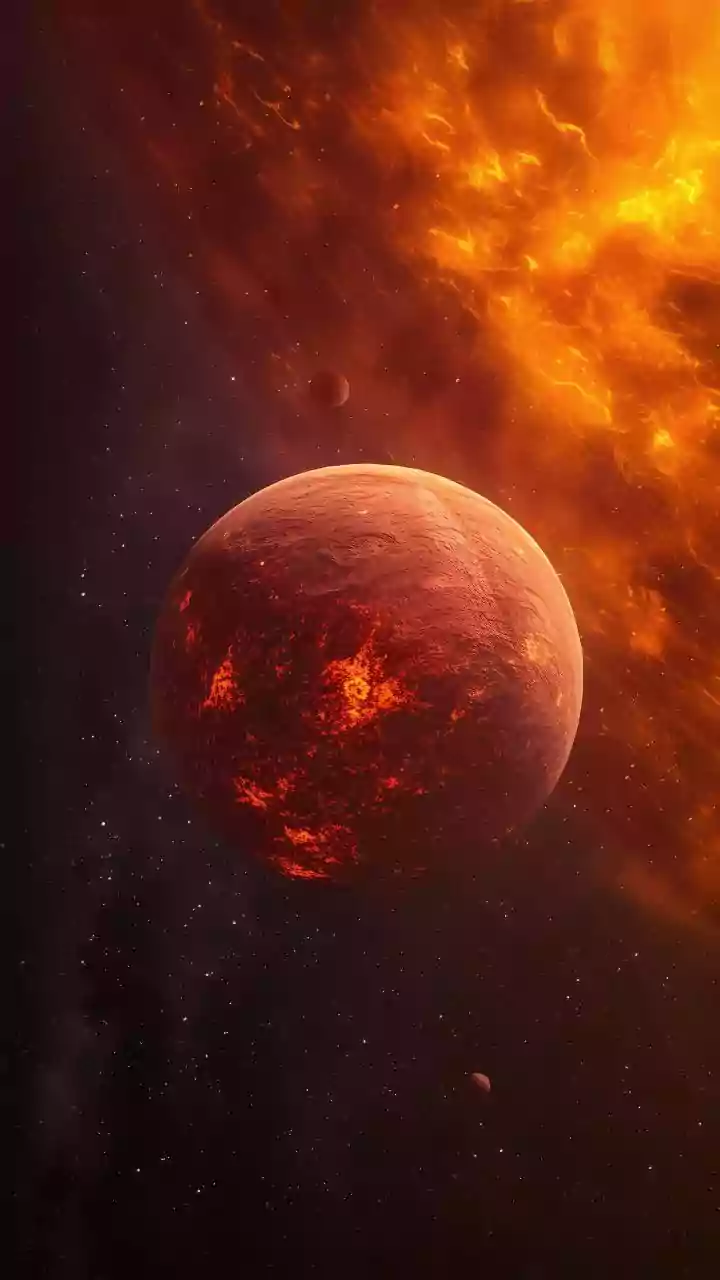
The temporal strangeness of Venus isn’t just a fun piece of trivia; it’s a crucial lesson in planetary science. It shows us that planets are not static balls of rock but dynamic, evolving systems shaped by violent histories and powerful ongoing forces. Each planet tells a unique story of its formation and evolution. Venus, our so-called 'sister planet' due to its similar size and mass, turned out to be less of a twin and more of a cautionary tale—a runaway greenhouse effect, a crushing atmosphere, and a day longer than its year.