





The Birth of a Digital Soul
At the heart of the trilogy's success is Caesar, a character brought to life with breathtaking depth by Andy Serkis. This wasn't just motion capture; it was 'performance capture'. Serkis, often hailed as a master of the form, didn't just provide movements
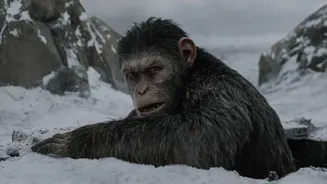
for a digital puppet; he delivered a fully-realised, emotionally complex performance that the VFX artists at Weta Digital then translated into the photorealistic ape leader. The technology captured every nuance of Serkis’s facial expressions, every flicker of doubt in his eyes, and every ounce of rage in his roar. This allowed audiences to connect with Caesar on a profoundly human level, making him one of the most compelling protagonists of 21st-century cinema. The trilogy proved that a CGI character could be the emotional anchor of a major film franchise.
Technology Meets the Wild
The visual effects evolved dramatically across the three films. 2011's Rise of the Planet of the Apes primarily used controlled sets, but its sequels, Dawn (2014) and War (2017), took the technology into the wild. Director Matt Reeves pushed to shoot on location in the rain-soaked forests of Vancouver and the snowy Sierra mountains, a monumental challenge for performance capture. Actors in specialised mo-cap suits performed alongside their human counterparts in complex, real-world environments. Weta Digital’s artists had to contend with unpredictable lighting, weather, and terrain to seamlessly integrate the digital apes into the live-action footage. The result was a stunning sense of realism. The apes didn't look like they were added in post-production; they looked like they inhabited the world, their fur matted with rain and dusted with snow.
Warfare as Character-Driven Storytelling
The headline promises “gripping battles,” and the trilogy delivered, but not in the way most blockbusters do. The action sequences were never just about spectacle; they were extensions of the characters' emotional journeys and the story's core themes. In Dawn, the initial clash between apes and humans is a tragic misunderstanding born of fear. In War, the battles are brutal, desperate struggles for survival, driven by Caesar’s quest for revenge and his internal conflict over losing his own humanity. Director Matt Reeves focused on telling the story from Caesar’s point of view, ensuring that every conflict was weighted with moral complexity and emotional stakes. This approach elevated the action beyond simple CGI mayhem, creating powerful, poignant set pieces that explored the nature of violence, empathy, and leadership.
A New Benchmark for Blockbusters
Ultimately, the Planet of the Apes trilogy is a masterclass because it redefined what a modern blockbuster could be. At a time when many big-budget films were criticized for prioritizing spectacle over substance, these films did both. They used cutting-edge technology not as a crutch, but as a tool to tell a deeply emotional and philosophical story about family, society, and the struggle for peace in a world defined by conflict. The journey of Caesar from a curious young chimp in Rise to a weary, mythic leader in War is a cinematic arc worthy of any classic tragedy. The films are not just about a planet of apes; they are a mirror reflecting our own world, our own conflicts, and our own humanity.