


The Standard Cosmic Recipe
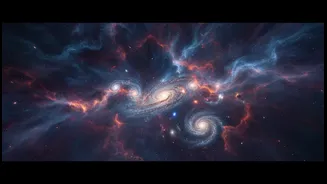
The prevailing theory of how galaxies form is known as the Lambda-Cold Dark Matter (ΛCDM) model. In simple terms, it's a story of gradual construction. After the Big Bang, tiny quantum fluctuations caused some areas of the universe to be slightly denser
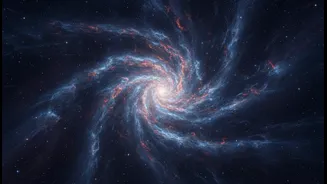
than others. Over hundreds of millions of years, the gravity of invisible 'cold dark matter' pulled these denser regions together, forming halos. Regular matter, the stuff we can see, was then drawn into these dark matter scaffolds, eventually igniting into stars and forming the first small, clumpy, and irregular galaxies. According to this model, large, well-ordered spiral and elliptical galaxies like our own Milky Way are the product of billions of years of mergers and acquisitions, as smaller galaxies collided and combined. This 'bottom-up' or 'hierarchical' model has been incredibly successful, explaining much of what we see in the large-scale structure of the cosmos.
A Plot Twist From the Early Universe
The game-changer has been the James Webb Space Telescope (JWST). With its unprecedented infrared vision, it can peer back in time to the cosmic dawn, observing galaxies as they were when the universe was just a fraction of its current age. And what it's finding is repeatedly surprising astronomers. Recent observations have unveiled galaxies in the early universe that are far more massive, complex, and chemically evolved than the standard ΛCDM model predicts should be possible. It’s like looking at a photograph from the 1800s and seeing someone using a smartphone. The timeline just doesn’t seem to add up, and this discrepancy is causing a wave of excitement and confusion in the astronomical community.
The 'Impossible' Early Structures
One of the most startling discoveries is the presence of well-ordered structures within very young galaxies. In mid-July 2026, astronomers announced the discovery of a 'nuclear disc'—a dense, rotating structure of stars at a galaxy's heart—in a galaxy as it appeared just 4.5 billion years after the Big Bang. Such features were thought to take much longer to develop. This find shows that galaxies may have developed complex internal systems much faster than traditional models suggested. Other research has pointed to galaxies that are too bright and massive for their age, suggesting star formation was far more efficient or happened much earlier than previously thought. These are not just isolated oddities; a growing pattern of 'impossibly' mature early galaxies has emerged from JWST data since its operations began.
Time to Rewrite the Textbooks?
So, is the standard model of cosmology broken? Not necessarily, but it is certainly facing some of its most significant challenges. The new discoveries don't mean the Big Bang didn't happen or that dark matter isn't real, but they do suggest that our understanding is incomplete. Scientists are now exploring several possibilities. Perhaps the first 'seeds' of dark matter halos were larger than assumed, allowing galaxies to grow more quickly. Maybe the processes of star formation and feedback from supermassive black holes are more efficient or work differently in the early universe than we understand. Some theories even propose that the fundamental rules governing cosmic expansion, or dark energy itself, might change over time, a possibility hinted at by other large-scale surveys. Researchers are now tasked with adjusting their simulations and theories to see if they can reproduce what the JWST is observing.