

What Exactly Is Space Weather?
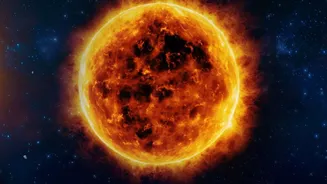
Space weather refers to the changing conditions in space, driven primarily by the sun. Think of it like terrestrial weather, but instead of wind and rain, it involves plasma, magnetic fields, and energetic particles. The sun constantly emits a stream
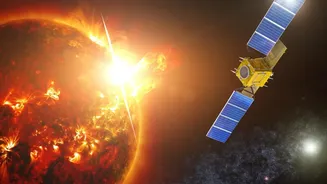
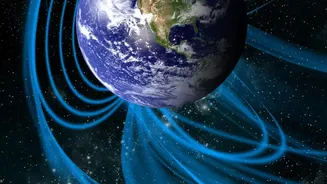
of charged particles called the solar wind. Sometimes, massive explosions on the sun's surface, known as solar flares or coronal mass ejections (CMEs), send huge bursts of energy and particles hurtling through space. When these are directed toward Earth, they can interact with our planet's magnetic field and atmosphere, causing what are known as geomagnetic storms.
The Triple Threat to Aviation
For aviation, a significant space weather event presents three main challenges: communication, navigation, and radiation. Solar activity can disrupt high-frequency (HF) radio communications, which are crucial for planes flying over remote areas like the poles where satellite coverage is limited. Secondly, the accuracy of the Global Positioning System (GPS) can be degraded. The charged particles from a solar storm disturb the Earth's ionosphere, the atmospheric layer that GPS signals must travel through. This can cause errors in position data, sometimes by several meters. Finally, solar radiation storms can increase radiation levels at high altitudes, posing a potential, though managed, risk to crew and passengers and, more significantly, to sensitive aircraft electronics.
How GPS Is Affected
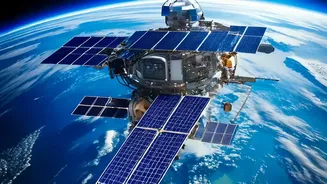
Modern aircraft rely heavily on GPS for precise navigation, especially during approaches and landings. When a solar storm hits, it supercharges the ionosphere with particles. This disturbance can bend and delay the radio signals from GPS satellites as they travel to a receiver on an aircraft. The result is that the plane's navigation system might calculate its position incorrectly. While errors are often small, the potential for degradation is why the industry has built-in redundancies. During a strong storm, the reliability of GPS can't be fully guaranteed, forcing pilots to rely on other systems.
The Pilot's Playbook: How Airlines Respond
You don't need to cancel your travel plans. The aviation industry has a well-established playbook for dealing with space weather. Global space weather centers monitor the sun's activity 24/7 and issue advisories to airlines and air traffic control. If a significant solar storm is forecast, airlines can take several proactive steps. The most common is to reroute flights. Polar routes, which are most vulnerable to radiation and communication blackouts, may be shifted to lower latitudes where Earth's magnetic field offers more protection. Airlines might also plan for flights to fly at lower altitudes, as the thicker atmosphere provides better shielding from radiation. In the cockpit, pilots can switch from GPS to backup navigation systems, like the Inertial Reference System (IRS), which tracks a plane's position using gyroscopes and accelerometers and is immune to space weather. Grounding flights is considered an extreme measure, reserved for only the most severe, and rare, events.