

Meet S/2023 U1, Uranus' Newest Companion
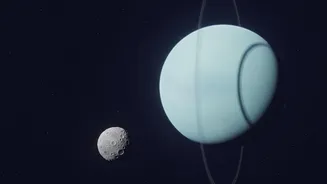
The newest confirmed member of Uranus’s family is provisionally named S/2023 U1. It’s a tiny object, estimated to be only about 8 kilometres in diameter, making it likely the smallest of Uranus's 28 known moons. This diminutive world follows a long, looping
path, taking approximately 680 Earth days to complete a single orbit around its parent planet. The discovery, officially announced in February 2024 by the International Astronomical Union's Minor Planet Center, was led by astronomer Scott S. Sheppard of the Carnegie Institution for Science. The find is significant as it’s the first new moon discovered around the ice giant in more than 20 years, offering a fresh chance to study the planet's complex satellite system. In keeping with tradition for Uranian moons, S/2023 U1 will eventually be given a permanent name from the works of William Shakespeare.
The Challenge: A Needle in a Cosmic Haystack
Finding a moon just a few kilometres wide orbiting a planet billions of kilometres away is an immense technological challenge. Uranus is so distant that even large celestial bodies appear faint. A tiny moon like S/2023 U1 is incredibly dim, with an apparent magnitude that makes it one of the faintest moons ever detected using ground-based telescopes. Its faintness is compounded by the overwhelming glare from Uranus itself, which can easily wash out any small objects nearby. Spotting these moons requires not only powerful telescopes but also highly specialised techniques to filter out background noise and amplify the faintest signals of light. It’s less like looking for a familiar object and more like searching for a single, specific pixel that moves in a predictable pattern across a vast, dark, and noisy canvas.
The Power of Digital 'Shift-and-Add'
The key to this discovery was a clever data processing technique. Sheppard and his team used the powerful 6.5-meter Magellan telescope in Chile to take a series of long-exposure images over several hours. In any single image, S/2023 U1 would be too faint to see. The breakthrough came from a method known as "shift-and-add." The telescope was programmed to track Uranus's motion across the sky. This means that in the resulting images, the background stars appear as trailed streaks of light, while Uranus and any objects orbiting it appear as stationary points. By digitally stacking these numerous exposures, aligning them on Uranus, the faint light from the tiny moon was amplified until it became a detectable pinprick against the smeared background of stars. This technique essentially pulls a nearly invisible object out of the darkness by combining many imperfect glimpses into one clearer picture.
From Faint Dot to Confirmed Orbit
Detecting a dot of light is only the first step; proving it's a moon is the real work. After the initial sighting in November 2023, follow-up observations were crucial. Astronomers had to track the object's movement over weeks to confirm it wasn't a distant asteroid just passing by. They then worked with experts at NASA's Jet Propulsion Laboratory to calculate its trajectory. This is where orbital data becomes paramount. By plotting its path, they determined it had a stable, inclined orbit consistent with being gravitationally bound to Uranus. The confirmation was cemented when Sheppard was able to find the same object in older images he had taken in 2021, providing a multi-year arc of its orbit and proving beyond a doubt that it was a long-term resident of the Uranian system.
Why These Tiny Discoveries Matter
Discovering small, irregular moons like S/2023 U1 provides crucial clues about the history of our solar system. These outer moons are believed to be captured objects—likely asteroids or comets that strayed too close to Uranus long ago and were pulled into orbit by its gravity. S/2023 U1 has a similar orbit to two other Uranian moons, Caliban and Stephano, suggesting they may all be fragments of a larger parent body that was shattered by a collision in the distant past. Studying these groupings helps scientists model the chaotic early days of the solar system and understand the processes that shaped the planetary systems we see today. Each new moon, no matter how small, adds another piece to the puzzle of planetary formation and evolution.