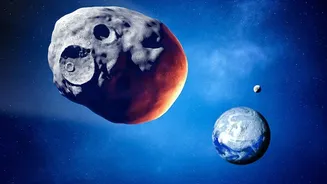


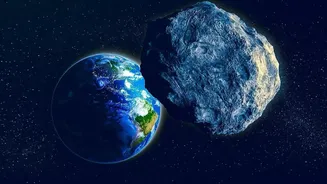
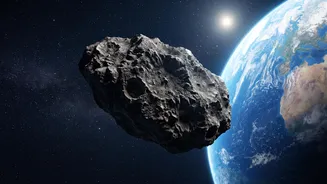
For the past few months, Earth has had a secret second moon. This tiny companion, a space rock about two metres wide, was captured by our planet's gravity but is now preparing to leave its orbit and continue its journey around the sun.
Meet 2026 QQ8, Our Temporary Guest
Astronomers have
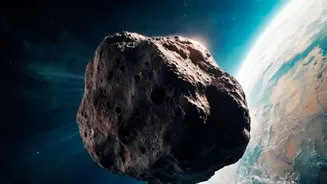
named our fleeting companion 2026 QQ8. First spotted in August 2026 by Hungarian astronomer Krisztián Sárneczky, it took several weeks of observation to confirm it was a natural object and not a piece of old space junk. The International Astronomical Union's Minor Planet Center officially designated it in late October. This 'mini-moon', a term used for asteroids temporarily caught in Earth's gravity, was pulled into our orbit back in April 2026. At only about two metres across, it's far too small and distant to see without powerful telescopes, but its brief stay is a fascinating reminder of our dynamic solar system. There is no danger of it hitting Earth; an object this small would simply burn up harmlessly in the atmosphere.
What Exactly Is a Mini-Moon?
'Mini-moon' is not an official scientific term, but it perfectly describes the phenomenon. These are typically small asteroids, often from the belt between Mars and Jupiter, whose paths bring them close to Earth. Occasionally, the combined gravitational pull of the Earth and our main Moon can trap these passers-by. Instead of flying past, they enter a complex, looping orbit around our planet. However, these orbits are unstable. Unlike our large, permanent Moon, mini-moons are only temporary visitors. A gentle gravitational nudge from the Sun or Moon is usually enough to kick them back out into an orbit around the Sun. A typical mini-moon might stay for around nine months and complete a few orbits before departing.
A Cosmic Goodbye
The brief dance of 2026 QQ8 with our planet is coming to a close. Its unstable orbit means that its time as Earth's satellite is limited. Sometime in early December, it is expected to reach a point where it will escape Earth’s gravitational grip and be flung back into its own orbit around the Sun. This is a natural and predictable part of the process for all mini-moons. While we are losing this small companion for now, its journey is not entirely over. Orbital calculations suggest its new path will bring it back into Earth's general vicinity every decade or so, though another capture is not expected anytime soon. The next notable close approach is forecast for 2058.
Not Our First Celestial Visitor
While the discovery of a mini-moon is always exciting, 2026 QQ8 is not the first of its kind. Astronomers have confirmed a handful of these temporary satellites in the past. In 2006, an asteroid named 2006 RH120 was discovered, which spent about a year orbiting Earth. More recently, 2020 CD3 was our companion for about three years. In fact, computer simulations suggest that at any given time, there might be one or two small, washing-machine-sized mini-moons orbiting Earth, most of them too small and faint to be detected with current technology. They are more common than we think, but discovering them is a major challenge due to their size and speed.
Why These Tiny Moons Matter
Studying mini-moons is incredibly valuable for scientists. They are essentially pristine samples of asteroids, delivered right to our cosmic doorstep. Analysing them provides insights into what asteroids are made of and how our solar system formed. Unlike meteorites that get altered or destroyed by Earth's atmosphere, mini-moons can be studied in their natural state. They are also considered perfect targets for future robotic missions. It would be much cheaper and faster to send a probe to a nearby mini-moon to collect samples than to travel all the way to the main asteroid belt. These small visitors could even serve as testbeds for future asteroid mining technologies or planetary defence strategies. With new, more powerful observatories like the Vera C. Rubin Observatory coming online, we can expect to find many more of these tiny, temporary companions in the coming years.