




The Sun’s Violent Outbursts
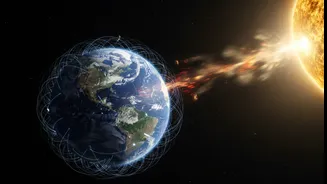
The Sun is not as calm as it appears. It constantly bubbles with magnetic energy, and sometimes this energy is released in two major ways: solar flares and coronal mass ejections (CMEs). A solar flare is an intense burst of radiation, like a giant flash
of light, that can reach Earth in just over eight minutes. A CME is a much larger eruption, where the Sun spews billions of tonnes of magnetised plasma into space. While slower, taking one to three days to reach us, a CME that hits Earth can trigger a geomagnetic storm, posing a significant threat to our technology. Understanding these events is the first step in protecting ourselves.
A Global Network of Solar Sentinels
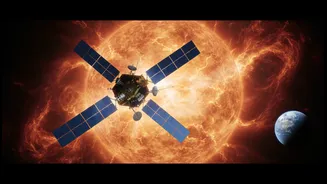
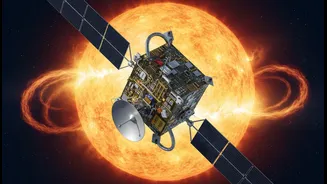
To keep an eye on our volatile star, space agencies around the globe operate a fleet of dedicated solar observatories. These robotic sentinels monitor the Sun 24/7. NASA’s Solar Dynamics Observatory (SDO) watches the Sun’s magnetic fields and atmosphere, helping scientists understand what creates solar activity. The joint ESA/NASA Solar and Heliospheric Observatory (SOHO) has been a workhorse for decades, studying the Sun from its core to the outer corona. More recently, India's Aditya-L1 mission, positioned 1.5 million kilometres from Earth, provides an uninterrupted view of the Sun. Its unique instruments are filling crucial gaps in our knowledge, particularly on how flares originate in the lower solar atmosphere.
From Data Streams to Forecasts
These observatories collect a torrent of data: images in different wavelengths, measurements of magnetic field complexity, and solar wind properties. This information is fed into sophisticated computer models run by organisations like NOAA’s Space Weather Prediction Center (SWPC) in the US and the Indian Institute of Science Education and Research (IISER). Researchers look for tell-tale signs of an impending eruption, such as the twisting and shearing of magnetic fields around sunspots. By combining real-time data with historical patterns, and increasingly using artificial intelligence, forecasters issue warnings about the probability, size, and potential impact of a solar storm.
What’s at Stake for Satellites?
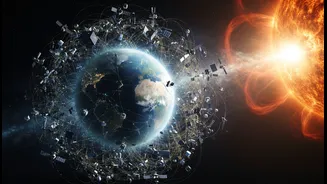
When a solar storm hits, satellites are on the front line. The effects can be devastating. Increased atmospheric drag from a heated and expanding thermosphere can cause satellites in low-Earth orbit (LEO) to lose altitude and even re-enter the atmosphere prematurely, as happened to a batch of Starlink satellites in 2022. High-energy particles can bombard a satellite's electronics, causing short-circuits, corrupting data, or permanently frying sensitive components. This radiation also degrades solar panels, shortening a satellite's operational life. Finally, the storm can disrupt the very radio signals used for communication and GPS, rendering them unreliable.
Taking Evasive Action
A forecast is useless without action. When the SWPC or another agency issues a warning, satellite operators spring into action. The advance notice—minutes for flares, days for CMEs—gives them a critical window to protect their multi-million dollar assets. Common procedures include putting the satellite into a protective 'safe mode', where non-essential and sensitive systems are temporarily powered down to reduce the risk of electrical damage. Operators can also reorient satellites to shield delicate instruments or even burn fuel to boost their orbit and counteract the increased atmospheric drag. For airlines, these forecasts can inform decisions to reroute flights, particularly over polar regions, to avoid communication blackouts and heightened radiation exposure for crew and passengers.