







The Sun's Turbulent Outbursts
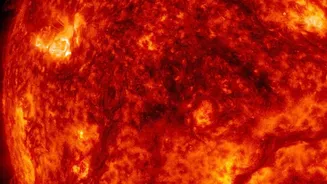
It all begins 93 million miles away with our seemingly life-giving Sun. The Sun is a magnetically chaotic star that frequently releases massive bursts of energy and matter. These events, known as solar flares and coronal mass ejections (CMEs), send torrents
of charged particles hurtling through space. While Earth's magnetic field, the magnetosphere, protects us from most of this solar wind, a particularly intense CME can overwhelm these natural defenses. When this highly energized plasma slams into our magnetic field, it causes a major disturbance—a geomagnetic storm.
An Invisible Attack on Electronics
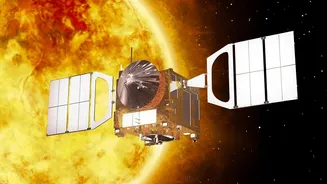
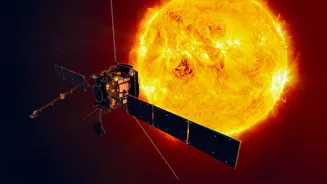
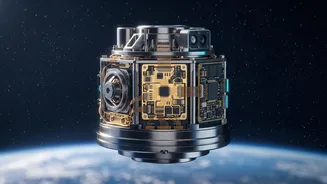
For a satellite orbiting outside the thickest parts of Earth's atmosphere, there's much less protection. During a geomagnetic storm, these spacecraft are bathed in high-energy protons and ions. Unshielded electronics are particularly vulnerable. When a high-energy particle strikes a sensitive microcircuit, it can leave a trail of ionization, essentially knocking electrons loose. This creates a tiny, unwanted pulse of electricity. While it might sound insignificant, in the microscopic world of modern processors and memory chips, this single event can have major consequences.
The Single Event Upset: A Cosmic Bit Flip
This phenomenon is known as a 'single event upset' or SEU. At its core, an SEU is a bit flip. A computer's memory and processor work by storing and manipulating billions of bits—the fundamental 1s and 0s of digital logic. A high-energy particle striking a memory cell can cause it to flip its state, changing a 0 to a 1, or vice versa. This is a 'soft error', meaning the hardware itself isn't permanently damaged, but the data it holds is now corrupted. If this bit flip occurs in a non-critical area, it might go unnoticed. But if it happens in the wrong place, the results can be catastrophic.
From Bit Flip to Wrong Turn
A spacecraft's guidance system is a complex web of sensors, processors, and thrusters, all working in concert to determine the vehicle's position, orientation, and trajectory. It constantly performs calculations to maintain its correct path. If an SEU occurs within the part of the processor or memory responsible for these calculations, it can introduce a critical error. A corrupted instruction or a faulty piece of data can lead the guidance system to make a wrong move. It might fire a thruster at the wrong time or for the wrong duration, subtly altering the satellite's course. Even a minor error in navigation, if uncorrected, can compound over time, causing the spacecraft to drift miles off course, potentially leading to a loss of mission.
The Shielding and Redundancy Dilemma
The reason the headline specifies 'unshielded' systems is key. Large, expensive government and military satellites are often 'radiation-hardened'. Their electronics are designed with more robust materials and built-in error correction, and they are encased in layers of shielding like aluminum or even gold foil to absorb and deflect radiation. However, shielding is heavy and expensive. In the era of commercial 'NewSpace' constellations, where thousands of smaller, cheaper satellites are launched, there's a strong incentive to reduce mass and cost. These less-shielded systems are more susceptible to SEUs. To mitigate this, engineers often rely on redundancy, such as using three computers and taking a majority vote on any decision, but the risk remains a fundamental challenge of operating in space.