








Our Sun's Violent Cousins
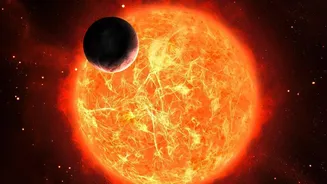
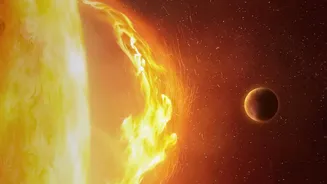
We often think of stars as steady, benevolent sources of light and heat, much like our own Sun. However, many stars are far more volatile. They can unleash stellar flares, which are sudden, intense bursts of energy and radiation. While our Sun has flares, they
are relatively mild compared to the 'superflares' produced by other stars, which can be thousands of times more powerful. These cataclysmic events release enormous amounts of high-energy X-rays and ultraviolet (UV) radiation, along with charged particles, that travel outwards through their solar systems. For any planet orbiting nearby, especially those in the habitable zone of a smaller, cooler star, this 'space weather' can be a constant and destructive force.
The Atmosphere-Stripping Effect
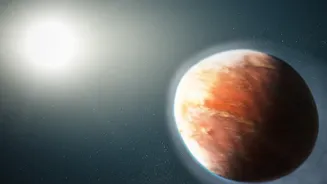
A planet’s atmosphere is crucial for life, providing breathable air, regulating temperature, and shielding the surface from harmful radiation. Stellar flares pose a direct threat to this protective blanket. The intense XUV (extreme ultraviolet and X-ray) radiation from a flare heats a planet's upper atmosphere, causing it to expand. This process, known as 'hydrodynamic escape', can be so powerful that atmospheric gases like hydrogen and helium are blown away into space. Observations with the James Webb Space Telescope have directly witnessed this process, capturing dramatic images of gas giants losing their atmospheres in colossal, comet-like tails. Over millions of years, frequent and powerful flares can completely strip a rocky planet of its atmosphere, leaving it barren and exposed. Studies have shown that it's often the more frequent, lower-energy flares that do the most cumulative damage over time.
The Red Dwarf Dilemma
This problem is especially acute for planets orbiting M-dwarf stars, also known as red dwarfs. These stars are the most common type in our Milky Way galaxy, making up about 70% of the stellar population. They are much smaller and cooler than our Sun, which means their habitable zone—the region where liquid water could exist on a planet's surface—is much closer to the star. This proximity makes planets easier to find, and many Earth-sized worlds have been discovered in these zones, such as around the famous TRAPPIST-1 system. However, red dwarfs are notoriously active, especially in their youth, with frequent and violent flares. A planet in the habitable zone of a red dwarf is therefore in the direct line of fire, subject to intense radiation bombardments that could make it uninhabitable.
More Than Just a Missing Atmosphere
Even if a planet manages to hold onto its atmosphere, stellar flares present other grave threats to life. The immense blast of UV radiation during a flare can be powerful enough to sterilize a planet’s surface, destroying complex organic molecules like DNA that are essential for life as we know it. These flares can also erode a planet’s protective ozone layer, further exposing the surface to deadly radiation. Computer simulations show that repeated flaring can also trigger dramatic chemical changes in the atmosphere and whip up powerful winds, creating an unstable and chaotic climate. This constant disruption makes it incredibly difficult for a stable environment, a key prerequisite for life's evolution, to establish itself.
Refining the Search for Another Earth
This does not mean the search for life is doomed, but it has become more nuanced. Scientists now understand that a planet's habitability depends on more than just its distance from its star. The star's age, temperament, and activity levels are equally critical. The 'Goldilocks zone' isn't just about being not too hot and not too cold; it's also about finding a quiet cosmic neighbourhood. Some research suggests flares might not always be destructive; in some cases, the UV radiation could help kick-start prebiotic chemistry. Ultimately, the challenge posed by stellar flares is forcing astronomers to refine their search, focusing on more stable, Sun-like stars or older, calmer red dwarfs. As powerful tools like the James Webb Space Telescope continue to analyse exoplanet atmospheres, they will provide crucial data on which worlds have withstood their star's fury and might just be able to call themselves home.