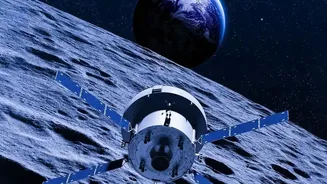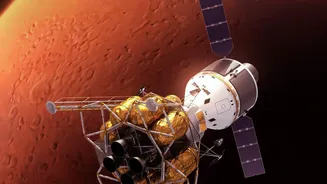







For decades, space exploration has been a conversation between Earth and the cosmos, limited by significant time delays. Now, a new paradigm is emerging: putting powerful AI hardware into orbit, turning spacecraft into autonomous decision-makers.
The Deep Space Delay Problem
Traditionally,
satellites and probes are sophisticated data collectors, but not thinkers. They gather vast amounts of information—images, sensor readings, and telemetry—and beam it back to Earth. This model has a fundamental weakness: the speed of light. Communicating with a rover on Mars can involve a delay of up to 20 minutes each way, making real-time control impossible. For missions in deep space, this delay stretches into hours or even days. This communication bottleneck means that spacecraft must often wait for instructions from ground control, slowing down exploration and making it impossible to react instantly to unexpected opportunities or dangers.
The Solution: An AI Brain in Orbit
Putting AI hardware into orbit—a concept known as edge computing in space—flips the script. Instead of sending massive streams of raw data back home for analysis, the spacecraft processes the information locally using powerful, onboard processors. This transforms the satellite or rover from a passive sensor into an active, intelligent agent capable of making its own decisions. It can analyze images, identify interesting geological formations, navigate around obstacles, or monitor its own health without waiting for a command from Earth. This shift dramatically reduces latency for critical decisions from hours to mere minutes.
Smarter Science and Faster Responses
The applications for on-orbit AI are transformative. Earth observation satellites can be trained to detect the early signs of wildfires, floods, or deforestation and send immediate alerts, rather than just transmitting terabytes of imagery for someone on the ground to analyze later. This allows for far more rapid disaster response. For planetary exploration, a rover equipped with AI can autonomously select which rocks are scientifically interesting enough to sample, massively increasing the efficiency of its mission, as seen with NASA's Perseverance rover. In astronomy, AI can filter out low-value data—like images obscured by clouds—and prioritize the most valuable information, saving precious bandwidth for transmission.
The Pioneers of Orbital Computing
A new ecosystem of companies and space agencies is racing to build this future. Tech giants like NVIDIA are developing specialized hardware, such as the Jetson and IGX platforms, designed for AI processing in space. Startups like Starcloud, Axiom Space, and Loft Orbital are creating orbital data centers and platforms to run AI applications. Starcloud even successfully trained an AI model in orbit in late 2025. These private ventures are working alongside legacy players like NASA and the European Space Agency (ESA), both of which are heavily investing in AI to enable more autonomous missions to the Moon, Mars, and beyond.
The Harsh Realities of Space
Putting a data center in space is not simple. The hardware must be 'radiation-hardened' to survive the constant bombardment of cosmic rays and solar particles, which can corrupt data and damage sensitive electronics. Managing heat is another enormous challenge; without air for convection cooling, spacecraft must rely on large, fragile radiator panels to dissipate the intense heat generated by powerful processors. Furthermore, these systems must be incredibly reliable, as a physical repair mission is often impossible. These engineering hurdles mean that while modern consumer chips are incredibly powerful, space-grade electronics have traditionally prioritized survivability over raw performance.