





Two Missions in One
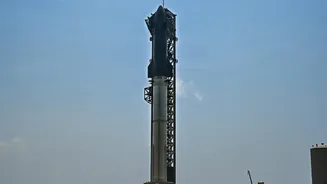
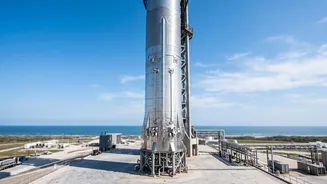
To understand Starship Flight 15, it helps to think of it as two separate but connected missions happening at once. The first involved the Super Heavy booster, the massive lower stage responsible for pushing the vehicle off the launch pad. Its job was
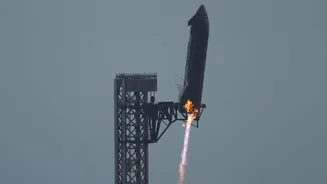
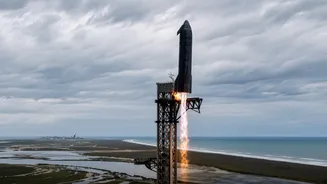
to perform its burn and then fly back to the launch site to be caught by the giant mechanical arms of the launch tower, nicknamed 'Mechazilla'. The second mission involved the Starship upper stage, or 'the Ship'. Its goal was more ambitious: to continue into orbit after separating from the booster, deploy a batch of Starlink satellites, circle the Earth, and then perform its own fiery reentry before being caught by the same tower. This flight was designed to test the full reusability of the entire launch system for the first time.
The Triumph: An Orbital Return and Catch
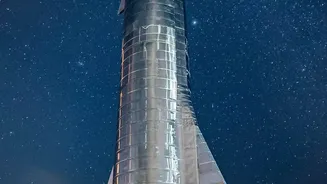
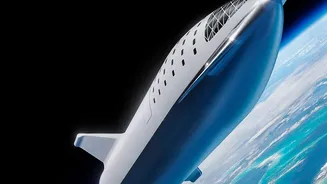
The undeniable success of the day belonged to the Starship spacecraft itself. After a nominal ascent and 'hot-staging' separation, where the Ship's engines ignited while still attached to the booster, it powered its way into a stable orbit. This alone was a landmark achievement, proving the vehicle could serve as a true orbital platform. While in orbit for approximately 22 hours, it successfully deployed 26 Starlink satellites. But the main event was its return. After completing 14 orbits, the ship performed a deorbit burn, survived a scorching reentry through the atmosphere, and navigated itself back to the Texas launch site. In the final, nail-biting moments, it reignited its Raptor engines, flipped into a vertical orientation, and descended into the waiting arms of the launch tower, which closed to secure it. This marked the first time an orbital-class upper stage has ever been recovered this way.
The Setback: What Happened to the Booster?
While the Starship was making history, its booster's mission ended differently. After a successful ascent, the Super Heavy performed its flip maneuver to begin the boostback burn, which redirects it toward the launch site. However, this burn ended prematurely. According to SpaceX, the booster's automated guidance system detected it was off-course and triggered an abort. Instead of continuing toward the tower for the catch attempt, the booster diverted to a safe splashdown zone in the Gulf of Mexico. It performed a landing burn over the water before its flight termination system was activated, resulting in its destruction. While the exact cause is under investigation, the system worked as intended by prioritizing safety and preventing the booster from heading toward land once a problem was detected.
Why This Is Still a Monumental Win
A lost booster might seem like a major failure, but in the world of SpaceX's iterative development, it's considered a valuable lesson. The company's philosophy is to build, fly, learn from failures, and rapidly improve. The primary and most difficult objective of the mission—getting the Ship to orbit and back for a catch—was achieved perfectly. Recovering an upper stage from orbital velocity is far more challenging than recovering a booster, as it endures significantly higher speeds and reentry heat. Successfully catching the Ship demonstrates that the hardest part of creating a fully reusable rocket system is viable. The booster's failure provides crucial data that will be used to improve the next iteration, a core part of a strategy that has allowed SpaceX to progress much faster than traditional aerospace programs. This 'successful failure' moves the company closer to its ultimate goal: a low-cost, rapidly reusable transportation system to space.