





What is the New US Rule?
On November 16, 2026, the U.S. Department of Commerce's Bureau of Industry and Security (BIS) announced an interim final rule designed to close a major loophole in its export controls on artificial intelligence (AI) technology. Previously, restrictions
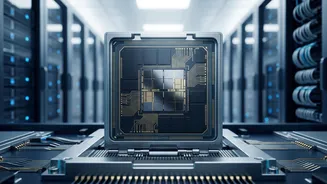
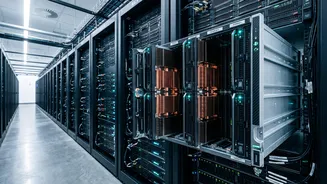
focused on preventing the physical shipment of high-performance AI chips to countries of concern, primarily China. However, companies in those nations could still access the power of these chips by renting computing time from data centres located in third countries. This new rule changes that. It requires a license to export, reexport, or transfer advanced AI chips to any data centre in the world if there is knowledge that it will provide significant computing power to companies headquartered in restricted countries. This effectively extends control from the physical hardware to the computing service itself, a model often called Infrastructure as a Service (IaaS).
The 'Remote Access' Loophole Explained
The core of the new regulation is tackling what is known as 'remote access'. Imagine you are barred from buying a supercomputer. The old rules stopped it from being delivered to your doorstep. But they did not stop you from logging into that same supercomputer from your laptop and using its power, as long as it was physically housed in a friendly country. Chinese AI firms were reportedly leveraging this method, using data centres in places like Singapore and Malaysia to train their AI models on advanced US chips they could not buy directly. The new rule makes this practice illegal without a license. It targets data centres that provide a significant volume of computing power—defined as over 12 million total processing performance (TPP)—to companies from restricted nations. This control applies even if the data centre customer is a subsidiary of a parent company headquartered in a country of concern.
Why Now? Geopolitics and National Security
This move is a direct response to the escalating tech rivalry between the US and China. US policymakers have grown increasingly concerned that China could use advanced AI for military applications, threatening American national security. The rule is described as a 'logical extension' of existing controls, aiming to prevent US technology from being used to train advanced 'Super Intelligence' models by adversarial nations. The timing was also influenced by a recent scandal involving the former CEO of Nvidia and a Singapore-based data centre company, which highlighted how third-country entities could allegedly serve as intermediaries to divert computing power to China. The rule is meant to ensure that sensitive US technology is not exploited in ways that threaten its foreign policy interests.
Who is Directly Affected?
The rule has a wide-ranging impact. US chipmakers like Nvidia and AMD, cloud service providers like Amazon Web Services (AWS) and Microsoft Azure, and data centre operators worldwide are on the front lines. They now bear a greater compliance burden, needing to know who their customers are and who ultimately controls them (a 'know-your-customer' or KYC protocol). Data centres already providing these services have a 90-day grace period to obtain the necessary licenses. The regulation also adds a new, destination-based license requirement for shipping advanced AI chips to five specific countries identified as having a 'higher-than-normal risk of diversion': Indonesia, Malaysia, Singapore, Thailand, and Brazil. This means even sales to these countries now face greater scrutiny.
Implications for India's Tech Sector
For India, the implications are complex. On one hand, the country is not a target of the restrictions. In fact, US technology firms continue to make massive investments in India's AI and data centre infrastructure. However, many Indian AI startups, researchers, and IT service firms rely heavily on US-based cloud services for their computing needs. While the rule does not target Indian companies directly, any disruption or increased compliance costs for global cloud providers could trickle down. The regulations place a new emphasis on verifying the end-user, which could add friction to accessing high-performance computing resources. Furthermore, earlier restrictions on AI models have already created competitive disadvantages for Indian firms. This new rule reinforces a global environment where access to cutting-edge AI is increasingly tied to geopolitical alignment, pushing India to accelerate its own domestic capabilities to avoid over-reliance on any single country.