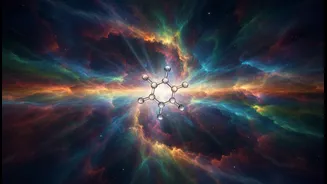




What on Earth Is Erythrulose?
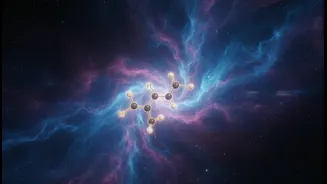
Erythrulose might sound exotic, but it’s a substance found right here on Earth. It's a simple, four-carbon sugar that naturally occurs in red raspberries. If you’ve ever used a sunless tanning lotion, you’ve likely encountered it there, too. It reacts
with amino acids in the skin to produce a temporary tan, a process similar to how a cut apple turns brown when exposed to air. While its terrestrial uses are interesting, its discovery 26,745 light-years away is what has the scientific community buzzing. This marks the first time a true sugar molecule has been directly identified in the vast emptiness of the interstellar medium—the dust and gas that exists between star systems.
Finding Sugar in a Cosmic Haystack
So, how do you find raspberry sugar near the galactic center? Scientists can't exactly scoop up a sample. Instead, an international team led by researchers in Spain used powerful radio telescopes to listen for the chemical's unique signature. Every molecule, when it rotates and vibrates, emits energy at very specific frequencies. Think of it as a molecular fingerprint. The team aimed their telescopes at a dense molecular cloud named G+0.693-0.027, a known stellar nursery where new stars and planets are born. By analysing the faint radio waves coming from this cloud, they found 12 distinct signals that perfectly matched the laboratory fingerprint of erythrulose, confirming its presence far from any raspberry patch.
The 'Prebiotic' Connection to Life
This discovery is more than just a chemical curiosity; it’s a major clue in the story of our origins. Erythrulose is considered a 'prebiotic' molecule—a chemical building block that precedes life itself. Sugars are fundamental to life as we know it. They form the structural backbone of RNA and DNA, the molecules that carry our genetic code. For years, scientists have wondered how these complex sugars first formed on early Earth, as lab experiments suggest it wasn't an easy process here. One leading theory is that they didn't form here at all. Instead, they were delivered to our planet billions of years ago by crashing comets and asteroids that had picked them up from interstellar space. Finding erythrulose floating in a star-forming cloud provides the first direct evidence that these essential ingredients are indeed available out there.
From Stardust to Biology
The existence of erythrulose in space suggests a cosmic supply chain for life. The process likely begins on the icy surfaces of tiny dust grains floating in cold molecular clouds. Simple molecules like glycolaldehyde and ethylene glycol, which are abundant in space, can combine on these grains to form more complex sugars like erythrulose. Over millions of years, these dust grains clump together, eventually forming comets, asteroids, and planets. Scientists estimate that millions of tonnes of erythrulose could have rained down on Earth during a period known as the Late Heavy Bombardment, about 4 billion years ago. This cosmic delivery could have seeded the young planet's oceans with the raw materials needed for the first biological processes to emerge, potentially leading to the first RNA and, eventually, all life.
The Practical Choices Ahead
This brings us to the 'practical choices' this discovery presents. For one, it validates the massive investments in radio astronomy and space exploration. Telescopes like the ones used in this study, and future observatories, are our only windows into these deep cosmic questions. The choice to fund this science is a choice to understand our own place in the universe. Furthermore, finding that the building blocks of life can form abiotically in space radically changes our perspective on extraterrestrial life. It suggests that the ingredients for life are not a fluke unique to Earth but are likely common throughout the galaxy. The practical choice, then, is to continue searching. This discovery doesn't just open up the possibility of finding other sugars like ribose—the 'R' in RNA—in space; it strengthens the argument that life itself might be a universal phenomenon.