




The Challenge of a Lunar Stroll
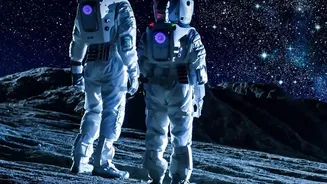
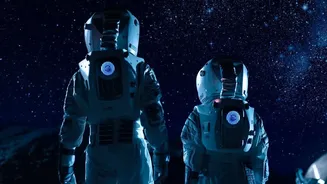
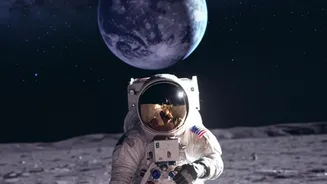
Walking on the Moon is not as simple as it looks. The combination of one-sixth of Earth's gravity and a bulky, pressurized spacesuit created significant challenges for the Apollo astronauts. The suits were stiff, making it difficult to bend at the knees,
waist, or elbows. This stiffness, combined with the fine, loose lunar dust, or regolith, underfoot, made maintaining balance a constant effort. The result was the famous “bunny hop” gait, which was more of a workaround for the suit’s limitations than an ideal way to move. For the upcoming Artemis missions, which aim to conduct more complex scientific work at the challenging lunar South Pole, a simple hop just won't do. Astronauts will need to bend, kneel, and walk with a more natural gait.
A New Generation of Mobility
Enter the Axiom Extravehicular Mobility Unit, or AxEMU, the next-generation spacesuit being developed for NASA by the commercial company Axiom Space. Building on NASA's own prototype designs, the AxEMU is engineered to provide a level of flexibility and mobility far beyond what was possible in the Apollo era. The key enhancements are in the joints. The suit utilizes innovative soft and hard joints, including bearings at the waist and multiple bearings in the legs, which allow for a much greater range of motion. This design will enable astronauts to bend down to collect rock samples, kneel to perform experiments, and walk with a stability that was previously unattainable. The goal is to move beyond mere survival on the surface and turn astronauts into effective field scientists.
The Commercial Partnership Model
The development of the AxEMU highlights a major shift in how NASA approaches space hardware. Instead of designing and building the suits entirely in-house, the agency has awarded a contract to Axiom Space to provide moonwalking services. Under this model, Axiom is responsible for the design, development, and production of the suits, while NASA defines the technical and safety requirements and retains authority over astronaut training and mission planning. This partnership leverages the innovation of the commercial sector to create advanced, cost-effective systems. Axiom even partnered with Italian fashion house Prada to contribute expertise on materials and manufacturing for the suit's outer layers. This approach allows NASA to focus on the broader goals of exploration while fostering a robust commercial space economy.
Why Better Balance Changes Everything
Improved balance and mobility are about much more than just preventing falls. For the Artemis III mission and beyond, astronauts will be exploring the lunar South Pole, a region of extreme temperatures and permanently shadowed craters that may hold water ice. Navigating this treacherous, uneven terrain safely is paramount. Greater flexibility means astronauts can perform more delicate and complex scientific tasks, handle specialized tools more effectively, and cover more ground during their extravehicular activities (EVAs). The AxEMU is also designed to fit a much wider range of body types, accommodating at least 90 percent of the U.S. male and female population, opening the door for more people to explore the lunar surface. This enhanced capability is crucial for establishing a long-term human presence on the Moon.
Testing for a Hostile World
Before the AxEMU touches lunar dust, it is undergoing a rigorous series of qualification tests on Earth to ensure it's ready for the harsh environment of space. Axiom Space and NASA teams are conducting tests in facilities that mimic lunar conditions. At NASA's Neutral Buoyancy Laboratory, astronauts practice movements in the suit underwater, where its weight can be adjusted to simulate the Moon's one-sixth gravity. Other tests involve thermal vacuum chambers that replicate the extreme temperature swings and vacuum of space, as well as vibration tables that simulate the forces of launch and landing. These extensive evaluations are critical for verifying the suit's safety, mobility, and life support systems before astronauts' lives depend on them hundreds of thousands of miles from home.