


The Old Goldilocks Dream
For decades, the search for habitable planets beyond our solar system has been guided by the “Goldilocks Zone.” This is the orbital band around a star where conditions are not too hot and not too cold, but just right for liquid water to exist on a planet’s
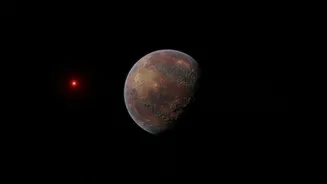
surface. The idea is intuitive: find an Earth-sized planet in this temperate zone, and you might just find another Earth. This concept has successfully guided astronomers to identify dozens of promising candidates out of the thousands of exoplanets now confirmed. Planets like the recently studied GJ 3378b, just 25 light-years away, generate excitement precisely because they orbit within this promising region. But as our tools and understanding have grown more sophisticated, scientists are realizing that location is just the beginning of the story.
The Naked Planet Problem
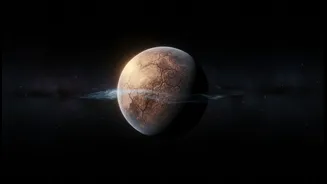
Imagine a cup of water in the vacuum of space. It wouldn't sit there peacefully. Instead, it would violently boil and freeze simultaneously as the lack of pressure rips its molecules apart. The same principle applies to planets. A world can be at the perfect temperature, but without a substantial atmosphere, any water on its surface is unstable. Liquid water requires pressure. On Earth, our atmosphere pushes down on everything with a pressure of about 1 bar (or 1,000 millibars) at sea level. This atmospheric blanket is what allows our oceans to remain liquid. On a planet with little to no atmosphere, like Mars, the surface pressure is less than 1% of Earth's. At that level, the boiling point of water plummets so low that it's essentially the same as its freezing point. Water can only exist as ice or vapor, making the prospect of flowing rivers and lakes impossible, regardless of temperature.
More Than Just a Pressure Cooker
An atmosphere does more than just provide the necessary pressure for liquid water. It also acts as a planet’s climate-control system. It traps heat through the greenhouse effect, keeping the planet's surface warm enough for liquid water, especially at the outer edges of the habitable zone. Without this effect, Earth’s average temperature would be a frigid -18 degrees Celsius. Atmospheres also distribute heat around the planet, preventing extreme temperature swings between day and night. For a planet to be truly habitable, it needs this stability. A world that roasts by day and flash-freezes by night is not a welcoming place for life to emerge. Therefore, a planet's ability to retain its atmosphere over billions of years is a fundamental component of its potential habitability, which depends on factors like its size and mass. Recent modeling suggests a planet needs to be at least 80% of Earth's radius to have enough gravity to hold onto its atmosphere long-term.
A New Era in Planet Hunting
This is where the next generation of observatories comes in. In the past, finding a planet in the habitable zone was the end goal. Now, it is the starting point. Telescopes like the James Webb Space Telescope (JWST) have an unprecedented ability to do what was once impossible: analyze the atmospheres of distant exoplanets. By capturing the light of a host star as it filters through a planet's atmosphere during a transit, scientists can look for the chemical fingerprints of different gases. The primary question is no longer just, “Is it in the right place?” but, “Does it even have an atmosphere?” This powerful capability allows astronomers to weed out the bare, lifeless rocks from the worlds that have a genuine chance of hosting liquid water. It’s a crucial filtering step that is refining the search for life in the cosmos.