






It All Starts With The Core
Before we dive into the specifics of arm and shoulder engagement, it's crucial to understand a fundamental principle of all paddling sports: true power comes from your core. A common mistake for beginners in both kayaking and stand-up paddleboarding (SUP)
is to rely solely on their arms, leading to rapid fatigue and potential strain. In reality, an efficient stroke in either sport is a full-body movement where the arms act as levers, transferring force generated by the larger, stronger muscles of your torso and back. Think of your abs, obliques, and lower back as the engine, while your arms and shoulders are the transmission and wheels. Engaging your core properly not only gives you more power but also improves balance and protects your shoulders from injury.
Kayaking: A Rotational Power Workout
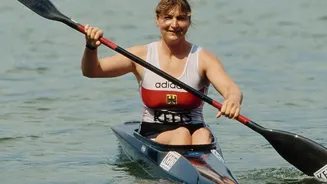
When you're seated in a kayak, your paddling motion is primarily rotational. As you pull one blade of the double-sided paddle through the water, you should be twisting your torso. This movement heavily recruits your back muscles, particularly the latissimus dorsi ('lats'), as well as your obliques. Your shoulders, specifically the deltoids, are engaged throughout the stroke to raise, lower, and guide the paddle. Your arms play distinct push-and-pull roles. The arm pulling the blade back works the bicep, while the opposite arm pushes forward, engaging the tricep and chest muscles. Because you're sitting, your lower body is less involved in balance and more focused on bracing, allowing for a more isolated and intense upper-body and core workout. This makes kayaking excellent for building rotational strength and endurance in the back and shoulders.
Paddleboarding: A Full-Body Balancing Act
Stand-up paddleboarding presents a completely different set of physical demands. The most obvious difference is the need for constant balance, which means your legs, glutes, and core are firing continuously just to keep you upright. The SUP stroke is more of a vertical, downward pull. It starts with a reach forward, engaging the shoulders and lats. The power phase involves pulling the paddle down and back through the water, which is a powerful workout for your lats, rhomboids, and rear deltoids. Your top arm acts as a lever, pushing down on the paddle handle and engaging the triceps and chest, while the bottom arm guides the pull. This creates a comprehensive upper-body workout that is less about rotation and more about vertical pulling strength and stabilization.
The Shoulder-to-Shoulder Comparison
So, how does this translate specifically to your shoulders? In kayaking, the repetitive rotational movement puts a specific kind of demand on the rotator cuff muscles, which are responsible for stabilizing the shoulder joint. Proper technique, involving torso rotation, is key to preventing overuse injuries in the shoulder. In contrast, SUP involves more overhead reaching during the 'catch' phase of the stroke. This can be great for building shoulder mobility and strength, but it also requires good stability to avoid impingement or strain. Essentially, kayaking focuses on the power and endurance of the larger shoulder muscles (deltoids) through a rotational plane, while SUP challenges the smaller stabilizing muscles of the rotator cuff through a wider, more vertical range of motion.
Which is Right for Your Fitness Goals?
Choosing between kayaking and paddleboarding depends entirely on your fitness objectives. If you're looking for an intense, focused upper-body and core workout that builds rotational power and endurance, kayaking is an excellent choice. The seated position helps isolate those muscle groups effectively. On the other hand, if you want a true full-body workout that challenges your balance, stability, and core from head to toe, stand-up paddleboarding is hard to beat. It's considered a low-impact activity that engages nearly every muscle, from your feet to your shoulders, making it a fantastic all-around conditioner. While both sports will definitely give your arms and shoulders a workout, the way they do it is fundamentally different.