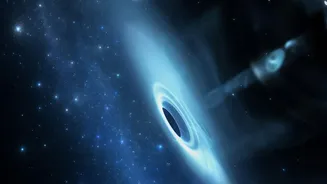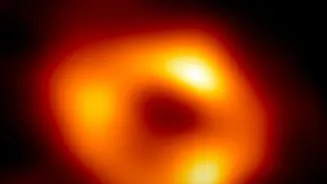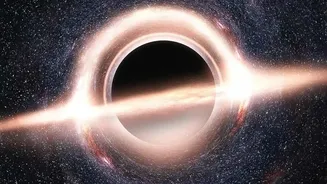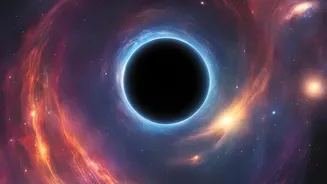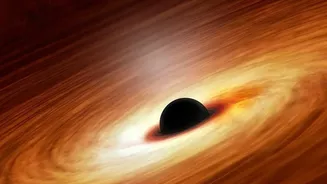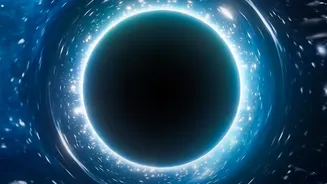





Black holes are the universe's ultimate titans, famous for pulling things in, not breaking apart. A fascinating theory about black hole fragmentation is now facing a major new hurdle, challenging our understanding of cosmic rules.
The Unbreakable Giant?
For decades, the rules
of the cosmos seemed clear: black holes merge, they grow, but they do not split. When two of these gravitational behemoths collide, they combine into a single, more massive entity, a process so violent it sends ripples through spacetime itself. The reverse—a single black hole spontaneously breaking into two smaller pieces—was largely considered impossible. This is due to a fundamental principle of physics known as entropy, which can be thought of as a measure of disorder in a system. For a stationary black hole, splitting into two would actually decrease the total entropy, a process that is thermodynamically forbidden, much like an egg spontaneously unscrambling itself. This entropy barrier has long been the primary reason scientists believed black holes were one-way gateways to growth, not fragmentation.
A Loophole in the Law
However, a recent theoretical study published in the journal Physical Review D has explored a potential loophole. Researchers investigated what might happen under the most extreme conditions imaginable, specifically when a black hole is spinning at, or very near, its maximum possible speed. Their calculations suggested that this extreme rotation could change the thermodynamic math. A rapidly spinning black hole has less entropy than a non-spinning one of the same mass. This creates a scenario where splitting could, in theory, become thermodynamically favorable, providing a narrow pathway for a single black hole to divide. The researchers even gave the process a quirky name based on its shape: a 'pair-of-pants topology', where one black hole splits into two 'legs'.
The New Physical Constraints
This is where the theory runs into its major new constraints. For fragmentation to be successful, it is not enough for the process to be merely possible; the two newly formed black holes must be able to escape each other. If they don't have enough momentum to fly apart, they will immediately fall back together and merge, negating the split entirely. When the researchers, led by Professor Francesco Sannino, factored in this crucial requirement, the already narrow window of possibility slammed almost shut. Their work reveals that only a black hole spinning at the absolute cosmic speed limit might be able to fragment. Any slower, and the resulting pieces would be doomed to an immediate reunion. This makes the conditions for a successful split exceptionally rare, pushing the theory to the very edge of physical possibility.
Why This Cosmic Debate Matters
While no one has ever observed a black hole splitting, this theoretical tug-of-war is more than just a curious academic exercise. It tests the absolute limits of our understanding of gravity and the universe's fundamental laws. Exploring these extreme scenarios helps scientists refine Einstein's theory of general relativity and consider what new physics might lie beyond it. The research suggests that smaller, primordial black holes—hypothetical black holes formed shortly after the Big Bang—might be more likely candidates for fragmentation than the massive ones we see at the centers of galaxies. According to Sannino, it might even be possible to indirectly search for signs of this phenomenon. Gamma-ray telescopes could potentially detect signals from tiny black hole fragments that might be created during cosmic events, offering a way to test this mind-bending idea.