








The Smart Traveller's New Tool
In the world of travel, knowledge is power. Increasingly, that power comes from On-Time Performance (OTP) data. For years, passengers felt helpless against sudden delays and cancellations. Today, armed with publicly available statistics, travellers are
turning the tables. They are actively filtering out airlines with poor punctuality records before even clicking 'book'. This shift represents a new era of consumer empowerment, where an airline's ability to stick to its schedule is becoming as important as price or baggage allowance. Official bodies like the Directorate General of Civil Aviation (DGCA) in India regularly publish these figures, making it easier than ever to see which airlines are hitting the mark and which are lagging. According to recent DGCA reports for May 2026, IndiGo led the pack in punctuality among major domestic carriers, while others showed more variable performance. This transparency is changing booking habits, as travellers prioritise reliability to avoid the stress and cost of unexpected delays.
Where to Find Punctuality Data
Finding airline performance data is simpler than you might think. In India, the DGCA is the authoritative source, releasing monthly reports on airline and airport punctuality. These reports are available on their website and detail the OTP of scheduled domestic airlines at major metro airports like Delhi, Mumbai, Bengaluru, and Hyderabad. Beyond official government sources, several third-party websites and apps offer robust tracking tools. Services like FlightAware, Flightradar24, and Cirium provide real-time and historical flight data, often with more granular detail than a simple monthly percentage. Many of these platforms even allow you to look up the historical performance of a specific flight number, giving you a clearer picture of its typical reliability. Even a simple Google search of a flight number will often yield its current status and a basic track record.
The Problem with Headline Numbers
Relying on an airline's overall annual or monthly OTP can be misleading. An airline might boast an 85% on-time record, but this is an average across its entire network. This single number masks significant variations. For instance, an airline’s excellent performance on low-traffic routes can easily hide chronic delays at congested hub airports like Mumbai or Delhi. Furthermore, some airlines have been known to 'pad' their schedules—allocating more time for a flight than it actually takes—to artificially boost their OTP stats. A flight from Delhi to Mumbai might have a listed duration of nearly three hours, even if the actual flying time is closer to 1 hour and 40 minutes, simply to absorb potential delays. This means a flight that consistently 'arrives on time' might still be taking much longer than it should. The single punctuality score doesn't tell you any of this.
The Power of Route-Specific Checks
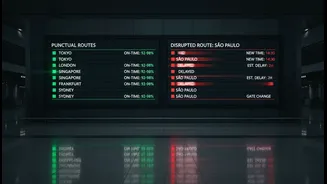
To get a true sense of your flight's likely punctuality, you must dig deeper into its specific route. An airline's performance on the busy Mumbai-Delhi corridor can be drastically different from a flight between Chennai and Kolkata. Factors like airport congestion, Air Traffic Control restrictions, and ground handling efficiency vary wildly from one airport to another. For example, DGCA data from May 2026 showed that Chennai airport had a stellar OTP of 92.2%, while Mumbai's was much lower at 70.5%. This directly impacts the flights operating from those airports. Similarly, Air India's performance in May was best at Chennai (89.5% OTP) but worst at Lucknow (62.4% OTP), highlighting massive route-dependent differences even within the same airline. Before booking, use flight tracking sites to check the history of the exact flight number you plan to take. This gives you a performance indicator for that specific service, which is far more valuable than a network-wide average.
Why Recent Performance Matters Most
An airline's performance six months ago is not nearly as relevant as its performance last week. Punctuality is highly sensitive to short-term and seasonal factors. In India, the monsoon season (June to September) can reduce all airlines' OTP by 5-10 percentage points. Likewise, winter fog in North India can severely disrupt schedules, particularly for flights departing from Delhi. Airlines also change their schedules, fleet assignments, and operational procedures, all of which can impact on-time performance. A route might get a new aircraft type or a revised schedule that improves or worsens its punctuality. Therefore, when you research a flight, focus on its track record over the last 30 to 60 days. This recent data provides a much more accurate forecast of what you can expect on your day of travel, factoring in current weather patterns and operational realities.