




The New Face of Corporate Fraud
Not long ago, the biggest social engineering threat was a poorly-spelled phishing email. Today, it’s a hyper-realistic video call from your CEO asking for an urgent wire transfer. This is the new reality of deepfake technology in the corporate world.
Using artificial intelligence, criminals can now clone a person's face and voice from publicly available data—like conference appearances or social media posts—to create convincing synthetic media. These attacks, often called 'CEO fraud' or 'Business Email Compromise (BEC),' exploit trust to bypass standard security protocols, leading to staggering financial and reputational losses. A recent report noted that a vast majority of businesses have already experienced financial consequences from synthetic media fraud, making this a C-suite level concern.
Anatomy of a Deepfake Attack
Imagine a finance department employee receiving a video call. On the screen is their CFO, looking and sounding exactly as they should. The CFO explains a confidential, time-sensitive acquisition and instructs the employee to transfer a large sum to a new vendor account immediately, bypassing the usual multi-person approval process to maintain secrecy. The urgency feels real, the authority is undeniable, and the visual confirmation seems absolute. Except, it's not the CFO. It’s an AI-generated deepfake. By the time the deception is discovered, the money is gone. This isn’t science fiction; it is a documented tactic that leverages sophisticated AI to prey on the human element, which is involved in a majority of security breaches.
Enter Biometric Verification Markers
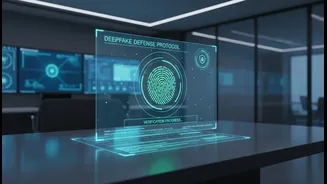
How do you fight a threat that perfectly mimics reality? You build a new layer of truth. Biometric verification markers are designed to do just that. Think of it as a secure, digital handshake that happens continuously and invisibly during a call. Instead of just authenticating a user at login, these systems constantly verify the person's identity using unique biological traits. This might involve analyzing subtle facial geometry, voice patterns, or even behavioral biometrics like typing cadence and mouse movements. This data is converted into a secure, encrypted marker, or digital watermark, that confirms two things: the participant is a live human being (not a recording or injection attack) and they are the specific person they claim to be.
The Case for a Company-Wide Mandate
Optional security measures create loopholes that attackers are quick to exploit. The primary reason for mandating biometric markers for all calls is to establish a universal baseline of trust. If the system is mandatory, its absence becomes an immediate red flag. A call without a verified biometric marker is treated as untrusted by default, regardless of how convincing it looks or sounds. This approach removes the burden of detection from individual employees, who are notoriously bad at spotting high-quality deepfakes. It transforms the defense from a subjective judgment call into an objective, automated protocol, ensuring that no single employee can be tricked into becoming the weak link in the security chain.
Balancing Security with Privacy
The prospect of employers collecting biometric data naturally raises significant privacy concerns. After all, you can't reset your face or voice like you can a password. To address this, leading solutions are designed with privacy at their core. Many systems perform analysis on the user's local device, meaning the raw biometric data never leaves their computer. Only the resulting encrypted verification marker is shared. Furthermore, these markers are often 'cancellable,' meaning if a marker is ever compromised, it can be revoked and a new one issued without compromising the underlying biometric data itself. This privacy-preserving architecture is crucial for employee buy-in and for complying with a growing number of biometric privacy laws.