




An Icy Moon with a Fiery Secret
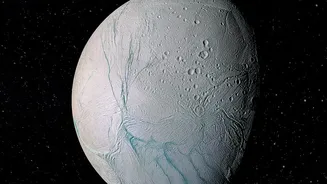
Enceladus might look like a quiet, frozen sphere, but it's one of the most geologically active bodies in our solar system. In 2005, NASA’s Cassini spacecraft made a startling discovery: more than 100 geysers were erupting from huge cracks near the moon's
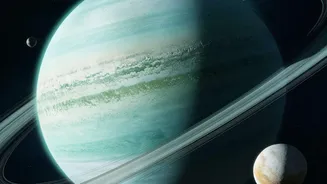
south pole, nicknamed 'tiger stripes'. These geysers blast a mixture of water vapour and ice particles hundreds of miles into space, forming a faint ring around Saturn known as the E ring. This stunning find immediately raised a profound question: what was feeding these plumes? The evidence pointed to something incredible—a vast, global ocean of liquid saltwater hidden beneath the moon's frozen crust, kept warm by tidal forces from Saturn's immense gravity. Suddenly, Enceladus transformed from a mere ball of ice into a prime candidate for extraterrestrial life.
The Right Tools for a Daring 'Taste Test'
To understand what was in these plumes, scientists couldn't just look; they had to get up close and 'taste' them. This is where the Cassini probe became an interplanetary chemist. The spacecraft was equipped with a suite of sophisticated instruments, but two were crucial for this task: the Ion and Neutral Mass Spectrometer (INMS) and the Cosmic Dust Analyzer (CDA). The INMS was designed to sniff out gases, identifying the chemical makeup of the plume's vapor. The CDA, meanwhile, was built to catch and analyze solid particles. When a tiny ice grain from the plume smashed into the CDA's detector at speeds of over 17 kilometres per second, it instantly vaporized, allowing the instrument to determine its composition. Together, these instruments gave scientists two different ways to analyze the material erupting from Enceladus's hidden sea.
A Deep Dive Through Icy Jets
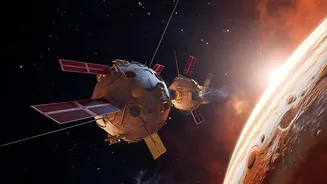
Armed with these tools, Cassini performed a series of audacious fly-throughs of the plumes between 2008 and 2015. These weren't gentle passes; the spacecraft plunged directly through the densest parts of the spray. On one of its deepest dives, Cassini flew less than 50 kilometres from the moon's surface, a truly daring manoeuvre for a mission of this scale. During these encounters, the INMS and CDA opened their metaphorical 'mouths' and collected samples. The CDA's high-rate detector counted thousands of ice particle impacts per second, giving scientists a sense of the sheer volume of material being ejected. It was a direct sampling of an alien ocean, a feat of navigation and engineering that provided an unprecedented glimpse into the world concealed beneath the ice.
An Ocean of Surprising Ingredients
The results from Cassini's taste-test were mind-blowing. The plumes were not just water. They contained a rich cocktail of compounds that hinted at a dynamic environment below. Scientists found salts, which confirmed the water was liquid and in contact with a rocky seafloor, much like Earth's oceans. They also detected molecular hydrogen, a key finding that suggests the presence of hydrothermal vents—underwater geysers—on the ocean floor. On Earth, such vents are teeming with life that thrives on chemical energy instead of sunlight. Even more exciting was the discovery of complex organic molecules, including nitrogen- and oxygen-bearing compounds that are precursors to amino acids. In 2023, analysis revealed the final key ingredient for life as we know it: phosphorus, found locked inside the ice grains. Enceladus's ocean appeared to have all the necessary building blocks for life.
The Next Generation of Plume Hunters
Cassini's mission ended in 2017, but its discoveries have paved the way for future exploration. The data sent back has made Enceladus a top-priority target for astrobiologists. In response, both NASA and the European Space Agency (ESA) are planning dedicated missions to return to this fascinating moon. NASA's proposed Enceladus Orbilander is designed to first orbit the moon, conducting many more plume-sampling flybys with next-generation instruments, before ultimately landing on the surface to search for evidence of life. ESA is also planning a mission that would include an orbiter and a lander, tentatively scheduled to launch in the 2040s. These future missions will build on Cassini's legacy, using advanced technology to get a much closer look at the habitable potential of this remarkable ocean world.