






The Unique Dangers of Monsoon Hill Driving
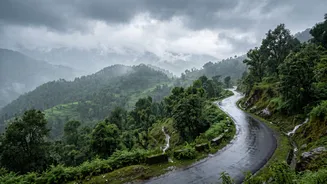
Driving in the hills during the monsoon is fundamentally different from driving on the plains. The primary threat is not just slippery roads, but the instability of the entire landscape. Heavy rainfall saturates the soil on steep slopes, dramatically
increasing the risk of landslides and mudslides that can block roads or, in the worst cases, sweep vehicles away. According to the Geological Survey of India, roughly 12.6% of the country's land area is prone to landslides, with the Himalayas and the Western Ghats being the two most vulnerable regions. Areas like Himachal Pradesh, Uttarakhand, and the ghats of Kerala and Karnataka frequently experience these events. Beyond landslides, drivers must contend with flash floods, where serene streams can turn into raging torrents in minutes, and rockfalls, where loose boulders dislodged by rain can crash onto the road. Visibility often drops to near zero in heavy downpours and fog, making it impossible to spot these hazards in time.
Your Pre-Drive Safety Checklist
Preparation is your first line of defence. Before you even put the key in the ignition, consult multiple sources for weather and road conditions. The India Meteorological Department (IMD) provides district-wise warnings, including alerts for heavy rainfall that could trigger landslides. Check for any 'Orange' or 'Red' alerts for your intended route. Beyond the forecast, check with local authorities or use official state websites for real-time road status updates, as many routes may be pre-emptively closed. Next, give your vehicle a thorough check. Ensure your tyres have good tread and are properly inflated for grip on wet surfaces. Your brakes, wipers, and all lights—headlights, tail lights, and fog lamps—must be in perfect working order. Also, make sure your car's defogger and air conditioning are functional to maintain clear visibility.
On the Road: Defensive Driving is Key
Once you are on the move, adapt your driving style to the challenging conditions. The most important rule is to slow down significantly; reducing your speed by about a third is a good rule of thumb on wet mountain roads. This gives you more time to react and increases your tyres' grip. Maintain a much larger following distance than you would on a dry road, as braking distances are longer and the car ahead might stop abruptly. Use lower gears when driving downhill to let the engine assist with braking, preventing your brakes from overheating. Stay firmly in your lane, especially on sharp curves, and use your horn to announce your presence before blind turns. Avoid driving at night, as your ability to spot debris, potholes, or signs of a fresh landslide is severely compromised. If you encounter a waterlogged section or a patch of debris, stop and assess the situation before proceeding.
What to Do If You Get Caught in a Landslide
Knowing what to do in a worst-case scenario can be life-saving. If you see signs of a landslide—like rumbling sounds, or trees and rocks moving—try to get away from its path as quickly as possible. Do not attempt to outdrive a large, fast-moving slide. Conflicting advice exists on whether to stay in the car or get out. If you are unable to drive away and debris is actively falling, your vehicle can act as a protective shell. In this situation, stay inside, curl into a tight ball, and protect your head. However, if you can safely exit the vehicle and move to higher ground away from the slide's path, emergency sources often recommend doing so, as cars can be buried or swept away. Never attempt to cross a debris field, and be aware that further slides can occur for hours or even days afterward. If trapped, use your car's hazard lights and horn to signal for help.