




A Library Written in Ice
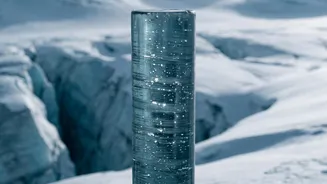
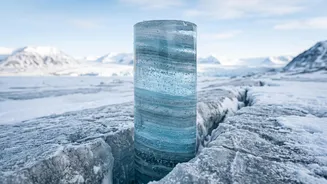
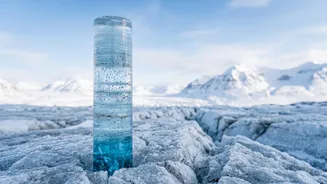
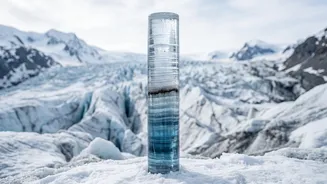
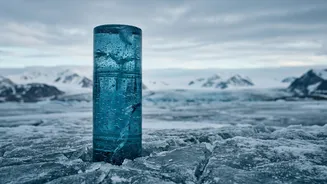
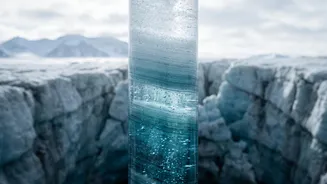
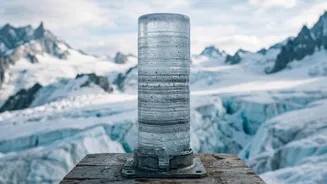
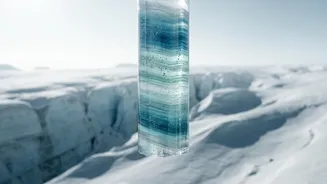
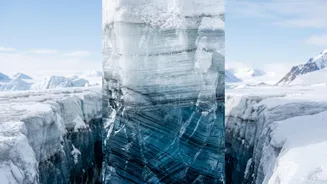
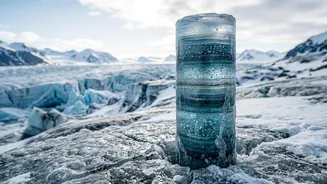
Imagine a record of Earth's atmosphere stretching back hundreds of thousands of years. That’s precisely what an ice core is. Scientists drill deep into ice sheets, extracting cylinders of ice that can be over three kilometres long. Each year, new snowfall
buries the last, creating distinct annual layers. As the snow gets compressed into ice, it traps everything from atmospheric gases and volcanic ash to sea salt and dust. By analysing these layers, from the newest ice at the top to the most ancient at the bottom, scientists can reconstruct a continuous, high-resolution timeline of past environmental conditions. Some Antarctic ice cores have provided a climate record stretching back 800,000 years.
Reading the Ancient Air
So, how do scientists read this frozen archive? Two key components provide a wealth of information: the ice itself and the tiny air bubbles trapped within it. The composition of the water molecules (H2O) in the ice reveals past air temperatures. Scientists analyse the ratio of heavy to light isotopes of oxygen and hydrogen. Because temperature affects how these isotopes evaporate from the ocean and travel to the poles, this ratio serves as a reliable 'paleothermometer', indicating how cold the air was when the snow fell. Meanwhile, the air bubbles are literal samples of the ancient atmosphere. Trapped as snow compacts into ice, these bubbles preserve the exact concentration of gases like carbon dioxide (CO2) and methane at that moment in time, allowing a direct comparison between temperature and greenhouse gas levels.
The Ocean's Ghostly Footprint
While air temperature is recorded directly, the ocean’s temperature leaves more of a ghostly footprint in the ice. Reconstructing past ocean temperatures is a more recent and complex innovation. One groundbreaking method involves analysing the noble gases—like argon, krypton, and xenon—trapped in the air bubbles. The solubility of these gases in ocean water is highly dependent on temperature. By measuring the precise ratios of these inert gases preserved in the ice, researchers can infer the mean ocean temperature at the time the air was trapped. This has allowed scientists to reconstruct ocean temperature changes over the last 700,000 years, offering a crucial, independent record to compare with atmospheric data from the very same core.
What Is a Climate Feedback Loop?
A feedback loop is a cycle where the output of a system influences its own operation. In climate science, these loops can either amplify a change (positive feedback) or dampen it (negative feedback). A simple positive feedback loop is ice-albedo feedback: warmer temperatures melt bright, reflective sea ice, exposing the dark ocean beneath. The dark water absorbs more solar heat, which in turn melts more ice, creating a self-reinforcing warming cycle. A negative feedback, by contrast, acts as a stabiliser. For instance, warmer conditions can increase plant growth, which absorbs more CO2 from the atmosphere, slightly counteracting the initial warming. Ice core records show how these loops have operated naturally over millennia.
The Great Climate Conversation
Ice cores reveal a long-running 'conversation' between the ocean and the atmosphere, driven by these feedback loops. Data from Antarctic ice clearly shows that during past ice ages, CO2 levels were low, and so were air and ocean temperatures. As the Earth warmed, often triggered by subtle shifts in its orbit, the oceans warmed and released vast amounts of stored CO2 into the atmosphere. This injection of a powerful greenhouse gas amplified the initial warming, creating a powerful positive feedback that pushed the planet out of an ice age. This process isn't one-way; the atmosphere also influences the ocean. Higher atmospheric temperatures increase water vapour (another greenhouse gas) and alter wind patterns, which affects ocean currents and its ability to absorb heat and CO2. Ice cores capture evidence of all these interconnected changes, from atmospheric gas concentrations to dust and sea salt levels that indicate shifts in wind and sea ice extent.