


A New Class of Worlds
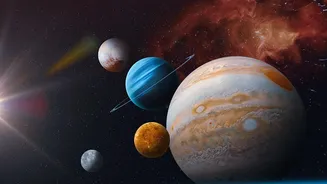
Our solar system provides neat categories of planets: small, rocky worlds like Earth and Mars, and gas giants like Jupiter and Saturn. But as we look out into the galaxy, the most common type of planet we find is something we don't have here at home:
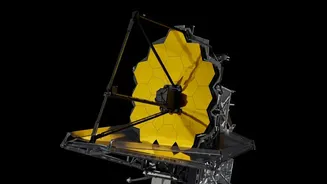
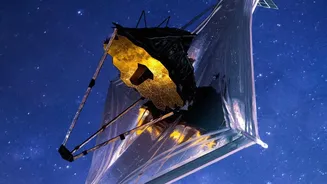
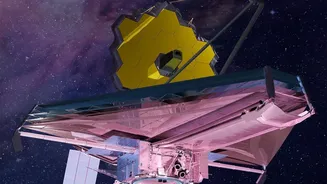
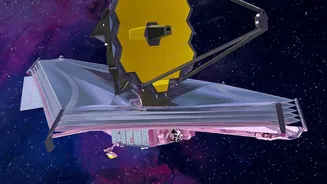
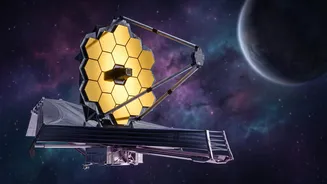
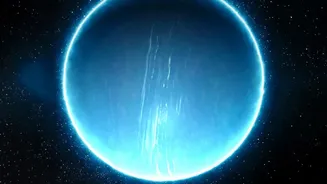
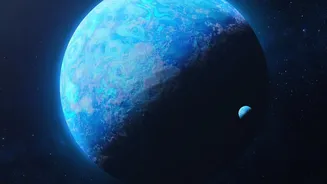
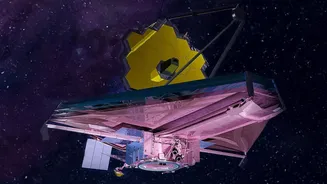
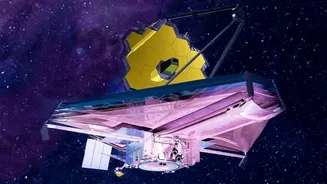
the 'Super-Earth'. These are worlds larger than Earth but smaller than Neptune. They are an enigma. Are they oversized rocky planets, or are they scaled-down gas worlds? The James Webb Space Telescope is finally equipped to answer these questions by dissecting the chemical makeup of their atmospheres, offering clues about what lies beneath.
Peering Through Alien Skies
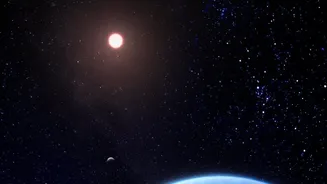
One of the most tantalising targets for the JWST has been K2-18 b, a super-Earth located about 124 light-years away. This planet is particularly interesting because it orbits within its star's 'habitable zone'—the region where temperatures could allow for liquid water to exist. Using its powerful infrared spectrographs, the JWST employs a technique called transit spectroscopy. As K2-18 b passes in front of its host star, the starlight filters through the planet's atmosphere. By analysing which colours of light are absorbed, scientists can identify the specific molecules present, creating a chemical fingerprint of that distant world.
The Telltale Signs of Water
Previous observations had hinted at water on K2-18 b, but the JWST has provided a much clearer picture. Its sensors have confirmed the presence of not just water vapour, but also carbon-bearing molecules like methane and carbon dioxide. The abundance of these molecules, and a notable lack of ammonia, strongly supports a fascinating hypothesis: that K2-18 b could be a 'Hycean' world. This is a theoretical type of planet defined by a vast, deep ocean of liquid water underneath a hydrogen-rich atmosphere. The name itself is a combination of 'hydrogen' and 'ocean'. While the telescope cannot see this ocean directly, the specific atmospheric mix it has detected is a strong indicator of a large body of water influencing the chemistry above it.
From Water to Habitability
Detecting water is a huge step, but the 'crucial details' lie in the context. The discovery of methane and CO2 alongside water is what truly excites scientists, as this mixture points towards a potentially habitable environment. Furthermore, some initial observations showed a tentative hint of another molecule: dimethyl sulphide (DMS). On Earth, DMS is almost exclusively produced by life, particularly marine phytoplankton. Scientists have stressed that this detection is not yet confirmed and requires more data to be verified. Even so, the mere possibility that JWST can detect such potential biosignatures is a revolutionary leap forward. It transforms the search for life from a theoretical exercise into an observational science. However, the path to confirmation is complex. On another super-Earth, GJ 486 b, JWST also found water vapour, but scientists are still debating if it's from a planetary atmosphere or from the cool spots on its host star.