





An Unplanned Lunar Encounter
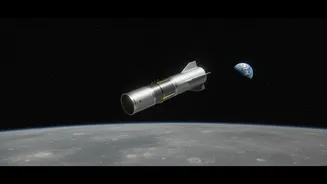
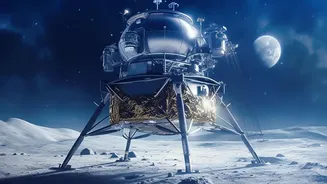
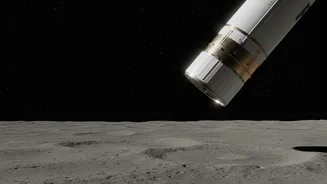
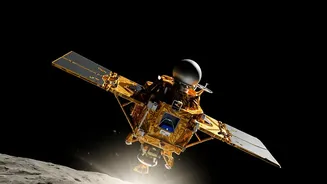
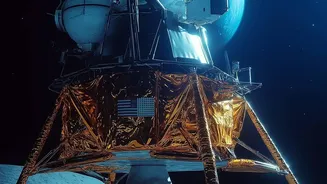
A spent upper stage of a SpaceX Falcon 9 rocket is scheduled to crash into the lunar surface on August 5. The rocket part has been in a meandering orbit since it completed its mission in January 2025, which involved deploying two commercial lunar landers.
After its job was done, the booster didn't have enough fuel to return to Earth or escape into deep space. Over the past year and a half, the complex interplay of solar activity and gravitational forces has nudged it onto a path that ends with a high-speed collision with the Moon. Astronomers tracking the object confirmed it has a 100% chance of impact near the Moon's Einstein and Bell craters. While unintentional, this event presents a rare and valuable opportunity for lunar science, turning a piece of space debris into a scientific probe.
The Science of Smashing Things
Crashing objects into the Moon is not a new idea; in fact, it's a proven scientific technique. In 2009, NASA intentionally slammed its LCROSS probe into a crater at the lunar south pole. The goal was to kick up a plume of material from a permanently shadowed region, areas of the Moon that haven't seen sunlight in billions of years. By analysing the composition of this ejected dust and gas cloud, scientists confirmed the presence of water ice hidden beneath the surface. This method, known as impact science, is one of the most effective ways to study the makeup of celestial bodies. The impact acts like a giant drill, excavating material from below the surface that orbiters can't see. Observing the resulting cloud of debris with spectrometers allows researchers to identify its chemical components, offering a window into the Moon's geology and resource potential.
India's Role in the Lunar Water Story
The quest for water is central to modern lunar exploration, and India has played a pivotal role in this story. The definitive proof of water ice on the lunar surface came in 2018 from data gathered by NASA's Moon Mineralogy Mapper (M3), an instrument that flew aboard India's first lunar orbiter, Chandrayaan-1. The M3 instrument was uniquely capable of distinguishing between liquid water, vapour, and solid ice, and it found definitive evidence of ice scattered in the shadows of craters near the poles. This landmark discovery transformed our understanding of the Moon, suggesting it could be a vital resource for future human exploration. Water can be used for drinking, growing plants, and can also be split into hydrogen and oxygen to produce breathable air and rocket fuel, making future lunar bases more self-sufficient.
What This New Crash Will Reveal
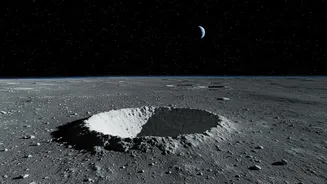
For the upcoming SpaceX rocket impact, scientists are ready. They know the object's mass, speed, and approximate impact location, which makes it a controlled, albeit accidental, experiment. Researchers will be eagerly observing the event to learn more about the physics of crater formation and how lunar dust, or regolith, behaves when blasted into space. This data is crucial for refining computer models that will guide future missions, both robotic and crewed. Spacecraft like NASA’s Lunar Reconnaissance Orbiter (LRO) will photograph the site before and after the collision to study the brand-new crater, which is expected to be up to 100 feet wide. Analysing the ejecta could also provide valuable information on the geology of a previously unexplored part of the Moon, adding another piece to the lunar puzzle.
A Glimpse into a Crowded Future
Beyond the immediate scientific gains, this event highlights a growing challenge: the increasing amount of human-made debris in the lunar environment. As India, the US, China, and private companies ramp up their lunar ambitions, the space around the Moon is becoming more crowded. This accidental impact serves as a reminder that a framework is needed for managing space traffic and debris to protect scientifically important sites and ensure the safety of future astronauts and bases. What is today a valuable scientific opportunity could, in the future, be a significant hazard. The Moon has no atmosphere to burn up incoming objects, so everything we leave behind stays there. This crash is a powerful lesson in both the potential and the responsibility that come with humanity's return to the Moon.