


Meet NASA’s Next Great Observatory
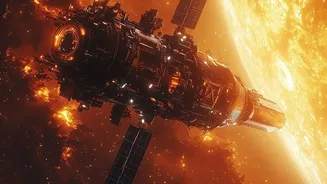
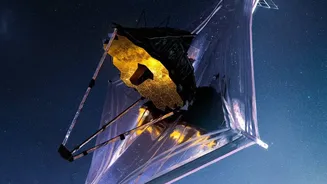
Set to launch by May 2027, the Nancy Grace Roman Space Telescope is NASA's next flagship astrophysics mission. While it has a primary mirror the same size as the Hubble Space Telescope's, its power lies not in seeing deeper, but in seeing wider. Much
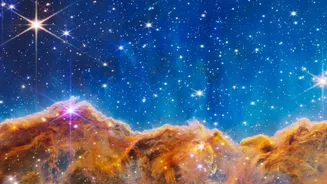
wider. This powerful observatory is engineered to tackle some of the most profound and puzzling questions in cosmology today, including the nature of dark energy and the prevalence of planets beyond our solar system. It’s a survey telescope, designed to map vast stretches of the universe with incredible speed and precision, creating panoramic images of the cosmos that would have taken Hubble centuries to capture. The mission will generate an unprecedented amount of data, helping scientists understand the structure and evolution of the universe on a grand scale.
A Panoramic View of the Universe
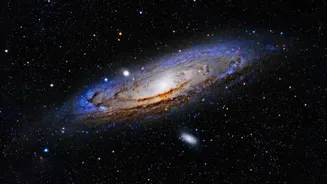
Roman's key advantage is its Wide Field Instrument (WFI), a 300-megapixel camera that gives it a field of view 100 to 200 times larger than Hubble's infrared instrument. To put that in perspective, while Hubble might focus on a single, distant galaxy with stunning detail, Roman can capture thousands of galaxies in a single shot. Imagine trying to understand a forest by studying one tree at a time; Roman is designed to photograph the entire forest at once, without sacrificing the clarity of the individual trees. This incredible survey speed will allow the telescope to image more than 50 times the area of sky that Hubble has covered in its entire 30-plus years of operation, all within its initial five-year mission.
Hunting the Universe's Dark Side
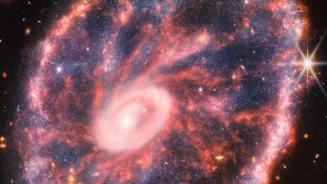
Roughly 95% of the universe is made of dark energy and dark matter, mysterious components that we cannot see or directly measure. We only know they exist because of their gravitational effects on the matter we can see. Dark energy is the name given to the unknown force causing the universe's expansion to accelerate. Roman will directly confront this mystery. By mapping the distribution of billions of galaxies across cosmic time and observing thousands of exploding stars called supernovae, the observatory will create a massive 3D map of the cosmos. This will allow scientists to measure how the universe's expansion has changed over billions of years, providing the most detailed look yet at dark energy's influence throughout history.
A Galactic Planet Census
Beyond the grand scale of cosmology, Roman will also conduct a revolutionary census of planets in our own galaxy. It will use a clever technique called gravitational microlensing, which occurs when a star and its planet drift in front of a more distant star. The gravity of the foreground star acts like a lens, briefly magnifying the light of the background star. The presence of a planet creates an additional, tell-tale blip in that magnification. This method is uniquely sensitive to planets with wide orbits and even 'rogue' planets that wander through space without a host star. While previous missions like Kepler found thousands of planets, they were best at spotting worlds in tight, close-in orbits. Roman is expected to discover thousands more, providing a more complete picture of the types of planetary systems that exist in the Milky Way.
A Tribute to the 'Mother of Hubble'
The telescope is named after Dr. Nancy Grace Roman, a trailblazing executive at NASA. As the agency's first Chief of Astronomy and the first woman to hold an executive position there, Roman championed space-based observatories at a time when the idea was still new. She was instrumental in bringing the Hubble Space Telescope from an ambitious concept to a groundbreaking reality, earning her the well-deserved nickname 'Mother of Hubble.' Naming this next-generation observatory in her honor is a fitting tribute to a scientist who overcame significant barriers and dedicated her career to expanding humanity's vision of the universe.