


A Divine Palate: The Essence of Bhog
The food prepared for Janmashtami is first and foremost a 'bhog'—a sacred offering made to Lord Krishna before being consumed by devotees. This act of offering food is an expression of love and devotion. The culinary traditions are deeply influenced by Krishna's
own story. Raised among cowherds in Vrindavan, his fondness for milk, butter (makhan), and other dairy products is legendary. Consequently, milk-based sweets and preparations are central to the festival. Items like Makhan Mishri (freshly churned white butter with rock sugar) are not just sweets; they are recreations of Krishna's childhood delights, offered with reverence. This emphasis on purity means all food is 'Sattvic'—prepared without onions, garlic, or eggs, using fresh, wholesome ingredients believed to promote a calm and clear mind.
The Grandeur of Chappan Bhog
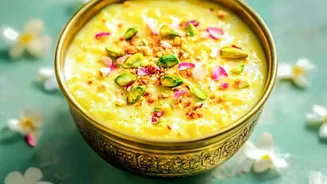
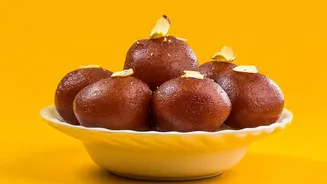
One of the most spectacular culinary traditions of Janmashtami is the 'Chappan Bhog', an offering of 56 distinct dishes. The number 56 is symbolic, rooted in a beloved legend where a young Krishna lifted the Govardhan Hill for seven days to protect his villagers from torrential rains, missing his usual eight meals a day. Grateful, the villagers presented him with 56 dishes (7 days multiplied by 8 meals) once the deluge ceased. This grand feast is a gesture of immense gratitude and includes a stunning variety of items: sweets like Kheer and Malpua, savouries such as Kachori and Pakoras, different types of rice and dal, chutneys, and pickles. While a full 56-item spread is usually seen in temples, families create their own smaller, yet equally heartfelt, versions at home.
Panchamrit and Panjiri: The Core Offerings
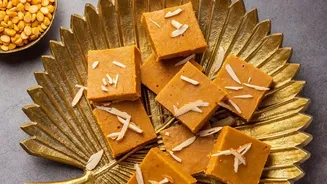
No Janmashtami puja is complete without Panchamrit and Panjiri. Panchamrit, meaning 'five nectars', is a sacred concoction of five ingredients: raw milk, curd, ghee, honey, and sugar. Each component holds symbolic meaning: milk for purity, curd for prosperity, honey for unity, ghee for strength, and sugar for sweetness. This divine drink is used to perform the ritual bathing of the infant Krishna idol and is then distributed as prasad. Panjiri, particularly popular in North India, is a nutritious sweet made by roasting wheat flour or coriander powder in ghee and adding sugar, nuts, and edible gum. Dhaniya (coriander) Panjiri is especially common as it is suitable for those observing a fast. Both offerings are not just ritualistic but are also packed with energy, meant to nourish the body after a day of fasting.
The Discipline and Delight of Fasting
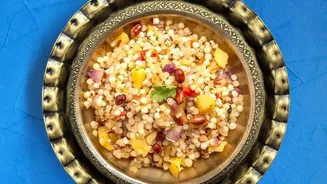
Fasting, or 'upvas', is a key aspect of Janmashtami, undertaken to purify the mind and body. Devotees observe different kinds of fasts; some abstain from both food and water ('Nirjala'), while others follow a 'Phalahar' diet, consuming only fruits, milk, and specific non-grain foods. The foods permitted during the fast are carefully chosen to be light and Sattvic. Popular 'vrat ka khana' includes dishes made from tapioca pearls (Sabudana Khichdi), water chestnut flour (Singhare ka Halwa), and buckwheat flour (Kuttu ki Poori). Rock salt (sendha namak) is used instead of regular table salt. These dishes provide sustenance and energy, allowing devotees to participate fully in the day-long prayers and midnight celebrations.
From the Altar to the Dining Table
The culmination of Janmashtami's food journey occurs at midnight, the moment of Krishna's birth. After the final prayers and aarti, the bhog offered to the deity becomes 'prasad'—blessed food to be shared among family and friends. This is the moment when the fast is broken. Sharing the prasad is a deeply communal act, transforming the sacred offering into a celebratory family meal. The grandeur of the Chappan Bhog and the simplicity of the vrat ka khana all merge into one, enjoyed together. It reinforces the idea that food on this day is not merely for sustenance; it is a powerful thread connecting devotion, tradition, and the joy of community.