






The Legend of the Seven Pagodas
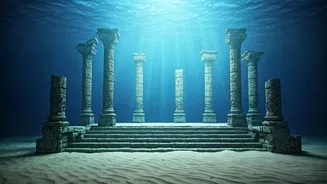
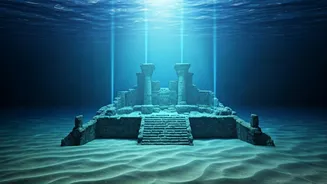
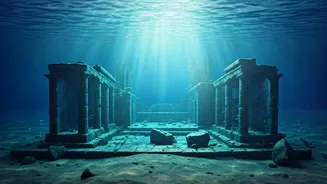
The story of the Seven Pagodas of Mahabalipuram has been passed down through generations. European sailors in the 18th century first chronicled the local tales of a magnificent coastal city with seven temples, so beautiful that the gods grew jealous and
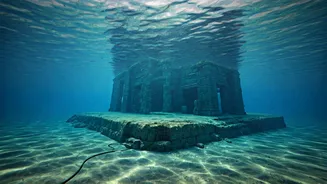
commanded the sea to submerge six of them. For a long time, with only the solitary Shore Temple standing as a sentinel against the waves, the story was dismissed by many as mere folklore. Local fishermen, however, remained adamant, claiming to have glimpsed the glittering tops of drowned structures beneath the waves on clear days. This persistent oral history kept the legend alive, suggesting that a significant part of this Pallava-era port city's history was not on land, but under the sea.
A Tsunami's Shocking Revelation
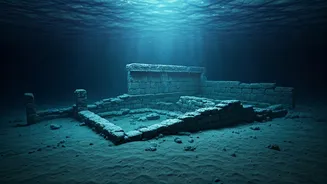
The tragic Indian Ocean tsunami on December 26, 2004, brought an unexpected and startling revelation. In the moments before the massive waves struck the coast, the sea off Mahabalipuram pulled back by as much as 500 meters. Eyewitnesses on the shore were stunned to see a long, straight row of large stone blocks and what appeared to be the ruins of walls and buildings emerge from the seabed, before being engulfed again by the returning water. The sheer force of the event also scoured away centuries of sediment from the coastline, uncovering previously buried statues, including a large, intricately carved lion from the 7th century CE. This dramatic, fleeting glimpse of a lost world shifted the legend from myth to a tangible archaeological possibility, demanding scientific investigation.
Technology Peels Back the Waves
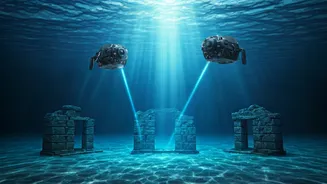
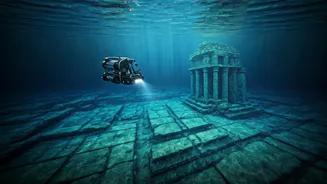
Spurred by the tsunami's revelations, the Archaeological Survey of India (ASI) and the Indian Navy launched expeditions to systematically map the seafloor. Their key tool was side-scan sonar, a technology that sends out acoustic pulses and reads the returning echoes to create a detailed image of the seabed's topography. By towing these devices from boats, researchers could effectively “see” through the water and sediment. Subsequent explorations by the National Institute of Oceanography (NIO) employed even more advanced tools, including Remotely Operated Vehicles (ROVs). These unmanned submersibles, equipped with high-resolution cameras, allow archaeologists to get clear visual documentation of submerged structures without disturbing the delicate underwater site.
What the Scans Uncovered
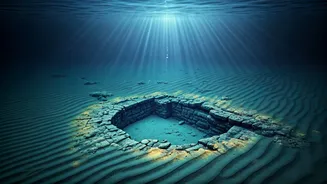
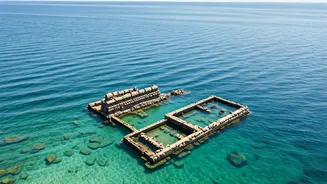
The sonar scans confirmed what eyewitnesses had seen, and more. The data revealed distinct anomalies that were clearly man-made. Researchers identified submerged walls, one stretching for nearly 70 meters, scattered stone pillars, and the layouts of what appeared to be at least two submerged temples and a cave temple within 500 meters of the shore. Dives confirmed these findings, revealing dressed stone blocks with chisel marks, platforms, and staircases, all heavily encrusted with marine growth at depths between five and eight meters. While not a complete city, the evidence strongly pointed to a significant, planned complex of structures that had been swallowed by the sea over time.
Rewriting a Chapter of History
These findings are profoundly significant, transforming a local legend into documented history. The structures discovered are believed to belong to the Pallava dynasty (7th-8th centuries CE), the same period as the Shore Temple. Some discoveries, such as brick structures, might even date back to the earlier Sangam period. Radiocarbon dating of marine growth on the stones suggests the submergence was not a single cataclysmic event, as the myth suggested, but a gradual process over centuries due to rising sea levels, coastal erosion, and possibly previous tsunamis. The work by the ASI and NIO provides concrete evidence that Mahabalipuram was a larger and more extensive port complex than what is visible on land today. Each new discovery helps piece together the puzzle of this great ancient seaport.