






Beyond the hustle of daily commutes lie architectural treasures waiting to be discovered. India's old railway stations are not just transit points; they are magnificent storytellers, whispering tales of imperial ambition and artistic grandeur.
Chhatrapati Shivaji Maharaj Terminus, Mumbai
A UNESCO
World Heritage Site, Mumbai's Chhatrapati Shivaji Maharaj Terminus (CSMT) is arguably the grandest railway station in India. Designed by British architect F.W. Stevens and completed in 1888 to commemorate Queen Victoria's Golden Jubilee, it was originally named Victoria Terminus. The structure is a breathtaking fusion of Victorian Gothic Revival and traditional Indian palace architecture. Look for the imposing central dome, gargoyles peering from the walls, intricate stained-glass windows, and pointed arches. The building's C-shaped plan is borrowed from Indian palace design, while the soaring turrets evoke European cathedrals. The entrance is famously flanked by statues of a lion, representing Great Britain, and a tiger, representing India, symbolizing the collaboration between the two. It took ten years to build and was the most expensive structure in Mumbai at the time, a true statement of the British Raj's power.
Lucknow Charbagh Railway Station
Resembling a magnificent palace, Lucknow Charbagh station offers a different architectural flavour. Completed in 1923 and designed by J.H. Horniman, it moves away from the purely Gothic style to embrace an Indo-Saracenic aesthetic, blending Rajput, Awadhi, and Mughal elements. Its name 'Charbagh' means 'four gardens', a nod to the Persian-style gardens that once graced its entrance. The station appears like a grand chessboard from an aerial view, with its large domes and minaret-like turrets creating a striking silhouette. More than just a transport hub, it holds a significant place in India's freedom struggle; it is believed to be the site where Mahatma Gandhi and Jawaharlal Nehru first met in 1916. The building was designed to impress, serving as a grand welcome to the city of Nawabs.
Howrah Station, Kolkata
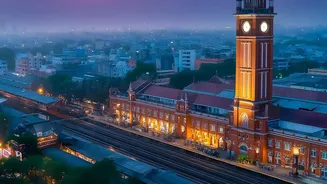
As one of India's oldest and busiest railway complexes, Howrah Station is an icon of Kolkata. Standing majestically on the banks of the Hooghly River, its distinctive red-brick facade and imposing clock tower make it instantly recognizable. The current heritage building, designed by British architect Halsey Ricardo, was opened in 1905. Its architecture is a functional blend of Romanesque and traditional British styles, characterized by massive arched windows and colonnaded verandahs. The station began its journey much earlier, in 1854, with a modest single-platform structure. Today, with 23 platforms, it serves as the gateway to eastern and northeastern India, handling over a million passengers daily. Despite its scale and constant activity, the station retains a powerful old-world charm.
Royapuram Railway Station, Chennai
While it may lack the ornamentation of its grander counterparts, Royapuram station in Chennai holds immense historical significance. It is the oldest surviving railway station in the entire Indian subcontinent. Inaugurated on June 28, 1856, it was the first station in South India and launched the region's first passenger service. The original building, designed in a quasi-classical style resembling a Regency-era mansion, still stands. Though it lost prominence to Chennai Central over time, it remains a proud monument to the dawn of railways in the south. The station was refurbished in 2005 to preserve its heritage, and it serves as a quiet reminder that history is not always found in the most grandiose structures.
Barog Railway Station, Himachal Pradesh
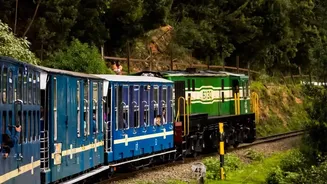
Nestled in the Himalayan hills, Barog station is a charming relic of colonial engineering on the UNESCO World Heritage Kalka-Shimla Railway line. Opened in 1903, the station is known for its quaint British colonial architecture, featuring stone walls and a classic sloping roof that perfectly complements its picturesque mountain setting. The station is named after Colonel Barog, the British engineer originally in charge of a nearby tunnel. According to local lore, a miscalculation in the tunnel's construction led to his deep despair. The new, successful Tunnel No. 33, the longest on the route, was built near the abandoned one and named in his memory. Visiting Barog is less about grand architecture and more about soaking in the atmosphere of a bygone era of mountain travel.