


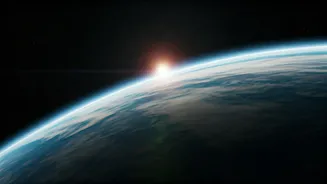


A Steamy Discovery 97 Light-Years Away
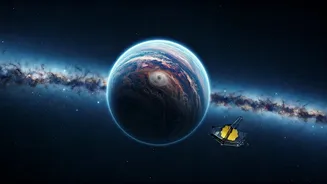
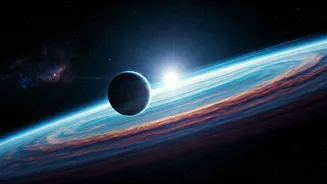
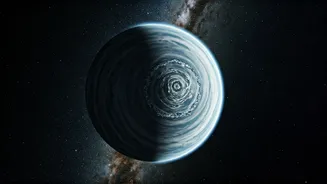
Scientists using the JWST, following up on earlier hints from the Hubble Space Telescope, have confirmed the presence of a significant amount of water vapour in the atmosphere of an exoplanet named GJ 9827d. Located 97 light-years away in the constellation
Pisces, this planet is about twice the diameter of Earth but is far from being an Earth-like twin. The discovery is a landmark moment, as it's one of the smallest exoplanets where water has been detected, pushing our analytical abilities into a new, more detailed phase of planetary science. The data suggests the world is not just laced with water, but could have an atmosphere almost entirely composed of steam.
How Webb Peeks Into Alien Skies
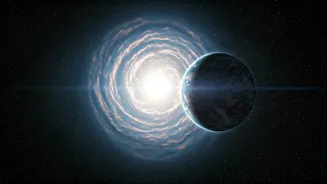
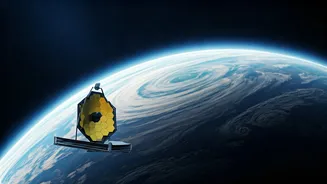
Detecting what an alien world's atmosphere is made of from nearly 100 light-years away sounds like science fiction, but it's a technique called transmission spectroscopy. When an exoplanet passes in front of its host star from our perspective, a tiny fraction of the starlight filters through the planet’s atmosphere. The JWST's powerful instruments, like the Canadian-made Near-Infrared Imager and Slitless Spectrograph (NIRISS), can analyze this light. Different molecules absorb light at specific wavelengths, leaving a unique chemical fingerprint. By reading this fingerprint, astronomers can identify the molecules present, such as the water vapour found on GJ 9827d.
The Search for Water Worlds
For astrobiologists, the search for life beyond Earth is largely a search for liquid water. Water is a fantastic solvent and is essential for the biological processes of every life form we know. This is why so much effort is put into finding planets within their star's 'habitable zone'—the orbital range where temperatures are just right for liquid water to exist on a planet's surface. While GJ 9827d itself is not in this zone, finding a planet so rich in water vapour is a crucial proof of concept. It confirms that planets can indeed form and retain vast quantities of water, a necessary ingredient for the potential alien oceans of the headline.
Not a Swimming Pool… Yet
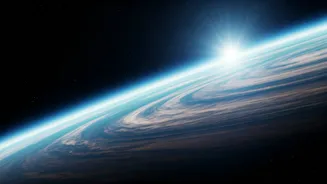
It's important to be clear: this discovery does not mean we've found an alien ocean. GJ 9827d is scorching hot, with surface temperatures estimated to be around 425 degrees Celsius, similar to Venus. If it were a water world, it would be an inhospitable, high-pressure steam bath, not a swimmable sea. Scientists have two main theories for what this planet is. It could be a 'mini-Neptune' with a puffy, hydrogen-rich atmosphere that also contains water. Or, more excitingly, it could be a new type of planet called a 'steam world'—a rocky core with a massive atmosphere made almost entirely of water vapour.
A Stepping Stone to Habitable Worlds
While GJ 9827d is not habitable for life as we know it, its discovery is a vital stepping stone. Confirming a planet with a heavy, water-dominated atmosphere, rather than a light hydrogen one, is a first. It proves that such worlds, long theorized, actually exist. This gives researchers a template for what to look for and how to interpret data from other, smaller, and potentially more temperate rocky planets. Future observations with the JWST will aim to detect other atmospheric molecules like methane and carbon dioxide, which could further hint at a planet's history and its potential to support life. Each discovery like this refines the search and brings us closer to finding a truly Earth-like world.