








A New Shape in the Clouds
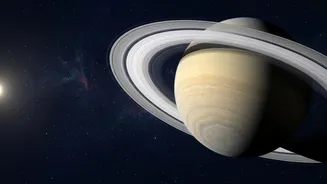
Recent observations from the Hubble Space Telescope have confirmed a colossal, 10-sided atmospheric pattern swirling around Saturn's south pole. This newly spotted feature, dubbed a decagon, is an enormous atmospheric wave embedded within one of the planet's
powerful jet streams. Astronomers report the structure is roughly 104,000 miles across, a scale so vast that a dozen Earths could fit inside it. The discovery came as a surprise, as Saturn’s south pole was tilted away from Earth and largely out of view for years. Hints of the structure first appeared in ground-based observations from amateur astronomers in 2024, but it was Hubble's sharp vision that confirmed its geometric nature in images from 2023 onward.
A Tale of Two Poles
For over 40 years, since the Voyager flyby, scientists have been captivated by Saturn's northern hexagon, a stable six-sided jet stream that has become an iconic feature of the planet. It was long considered a unique oddity. The discovery of a southern polygon changes that, suggesting such geometric storms might be a more fundamental aspect of Saturn's behavior. However, the two are not identical twins. The northern hexagon is remarkably stable and has persisted for decades. In contrast, the southern decagon appears to be a much newer phenomenon, seemingly having formed only in the last few years. It also appears less stable than its northern counterpart. This has given scientists a rare chance to watch a planetary-scale weather pattern develop in near real-time.
The Science of Planetary Polygons
While a 10-sided storm might sound like science fiction, these shapes are rooted in the complex physics of fluid dynamics. Gas giants like Saturn have powerful jet streams—rivers of gas moving at different speeds at different latitudes. Instabilities in these flows can create standing waves that, under the right conditions, lock into stable geometric shapes. Laboratory experiments with spinning tanks of liquid have been able to replicate similar polygonal patterns, proving the concept. The number of sides—six versus ten—is significant, as it relates directly to the properties of the jet stream that contains it. The emergence of a decagon points to a southern jet stream configured very differently from the one in the north.
An Unfolding Mystery
The discovery raises more questions than it answers. The most intriguing puzzle is why the decagon formed so recently. NASA's Cassini spacecraft orbited Saturn from 2004 to 2017 and saw no evidence of a long-lived polygonal storm at the south pole. This suggests the decagon is a new development, one that has become more pronounced since 2023. “The question is, why did it suddenly form now when we haven't seen one before?” asked Amy Simon, a NASA scientist involved in the study. Unlike the stationary hexagon, the decagon also appears to be slowly migrating. Scientists are now eager to track its evolution to see if it will stabilize into a permanent feature like the hexagon or dissipate over time.