







The Brain on Pen and Paper
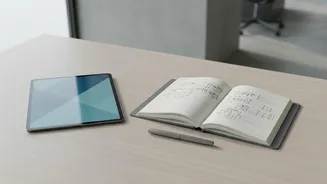
When you write by hand, your brain is doing more than just recording words; it's actively learning. Research shows that forming letters by hand engages complex neural networks related to motor skills, sensory processing, and memory. This process is more cognitively
demanding than typing, which often leads to mindless transcription. Because handwriting is slower, it forces you to summarise, prioritise, and rephrase information in your own words. This act of deeper processing helps to encode information more securely in your memory, leading to better recall and understanding of complex concepts long after the meeting ends.
Focus and Engagement in a Distracted World
Picture a typical meeting room: glowing laptops, phone notifications, and the quiet hum of an AI bot recording the conversation. While digital tools promise efficiency, they are also gateways to distraction. The act of putting pen to paper offers a powerful antidote. It’s a deliberate, single-tasking activity that minimises digital interruptions and sharpens your focus on the discussion at hand. Furthermore, taking handwritten notes sends a clear, non-verbal signal to colleagues and clients. It shows you are actively listening and that their contribution is important enough to be written down, which can help build trust and rapport.
Where AI Note-Takers Shine
This isn't to say that AI note-taking tools don't have their place. Their advantages are significant and clear. AI assistants are unmatched for creating a comprehensive, searchable record of a conversation. They can produce accurate transcripts, generate instant summaries, and identify action items, saving valuable time and administrative effort. For large-scale meetings, collaborative projects where notes need to be shared instantly, or for professionals who need an accessible record, these tools are invaluable. They capture nearly everything said, whereas even the most diligent handwritten notes capture only a fraction of the conversation.
Capturing What Matters vs. Capturing Everything
The core difference between the two methods lies in what they are designed to do. AI captures what was said; handwriting helps you process what it means. An AI transcript provides a perfect record of the words spoken, but it often misses the nuance—the hesitation before an agreement, the subtle shift in tone, or the ideas left unsaid. Experienced professionals often find that their handwritten notes don't aim to be a transcript. Instead, they become a curated record of insights, connections, and strategic observations that an automated summary might overlook. The scribbled arrow connecting two seemingly unrelated points or a quickly drawn diagram can hold more strategic value than pages of verbatim text.
A Hybrid Approach for Modern Professionals
The most effective strategy isn't choosing one method over the other, but blending them. Use an AI assistant to handle the heavy lifting of capturing the full conversation for a searchable archive. This frees you up to engage in the meeting more fully, using a notebook to jot down key insights, map out complex ideas, and track the subtle dynamics in the room. This hybrid approach gives you the best of both worlds: the comprehensive, searchable record from AI and the enhanced learning, focus, and strategic insight that comes from writing things down by hand. It’s about leveraging technology for what it does best—information storage—while reserving the uniquely human skill of sense-making for yourself.