





The End of an Era Creates an Opportunity
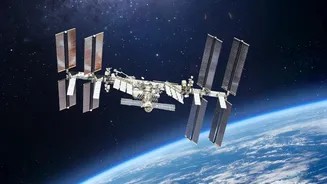
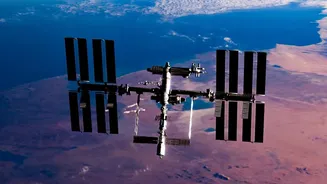
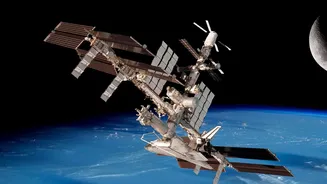
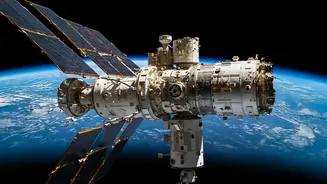
The International Space Station has been a triumph of global collaboration and scientific discovery, hosting nearly 300 astronauts from 26 countries. But after more than 25 years in orbit—well beyond its original 15-year design life—the aging outpost
is facing structural issues and rising maintenance costs, prompting NASA to plan for its deorbit by 2030. This impending retirement creates a critical challenge: without a successor, the United States and its partners risk losing continuous human access to low-Earth orbit (LEO) for the first time in a generation. Rather than build another government-owned station, NASA is turning to the private sector. Through its Commercial LEO Destinations (CLD) program, the agency is fostering a new market, acting as an anchor customer to help fund the development of privately owned and operated space stations. This strategy is designed to lower costs, spur innovation, and create a vibrant orbital economy.
The New Architects of Orbit
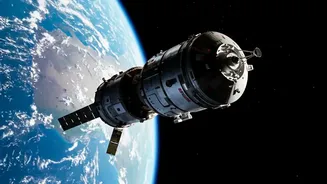
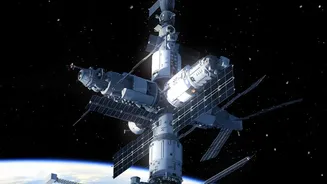
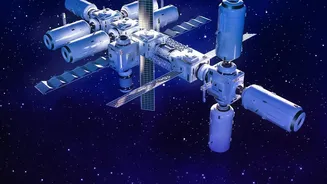
A handful of ambitious startups are at the forefront of this commercial shift, each with a unique approach to building humanity's next home in space. Axiom Space is taking a modular route, initially planning to attach its first habitat modules to the ISS before separating to become a free-flying station. The company has already flown private astronaut missions to the ISS, giving it valuable operational experience. Another major player, Vast, is developing the Haven-1 station, with plans to launch as early as 2027, potentially becoming the first standalone commercial station. Vast's long-term vision even includes developing habitats with artificial gravity. Meanwhile, a partnership between Blue Origin and Sierra Space is developing Orbital Reef, envisioned as a 'mixed-use business park' in space. Other ventures like Starlab, a joint project from Voyager Space and Airbus, are also in the running, competing to have their platforms operational before the ISS takes its final plunge.
Blueprints for Life in a Vacuum
Designing a commercial habitat involves more than just putting a metal can in orbit; it requires rethinking how humans live and work in space. Two main design philosophies have emerged: traditional rigid modules and innovative inflatable habitats. Axiom is working with Thales Alenia Space to build conventional metallic modules, similar in principle to the segments of the ISS. In contrast, Sierra Space is pioneering the Large Integrated Flexible Environment (LIFE) habitat, an inflatable module that launches in a compressed state and expands in orbit to offer a vast interior volume. These soft-sided structures are made from layers of high-tech fabrics like Vectran that become rigid when pressurized and are robust enough to withstand the harsh environment of space, including micrometeoroid impacts. Regardless of the structure, all designs must incorporate advanced life support systems to recycle air and water, generate power via solar arrays, and provide robust radiation shielding—all while being cost-effective enough to sustain a commercial business model.
More Than Just a Science Lab
Unlike the government-funded ISS, these new commercial stations are being designed with diverse revenue streams in mind from day one. While NASA and other national space agencies will be key customers, buying time for research and astronaut training, the business model extends far beyond government contracts. The players envision a future market that includes in-space manufacturing of unique materials like high-purity fiber optics or pharmaceuticals, which can be produced more effectively in microgravity. Space tourism is another major target audience, with companies designing modules that feature large Earth-viewing windows and accommodations for private astronauts. Furthermore, these stations will offer sovereign nations the ability to conduct their own space programs and fly their own astronauts without the immense cost of building their own infrastructure, effectively democratizing access to space.