








The Silent Saga of Mangalyaan
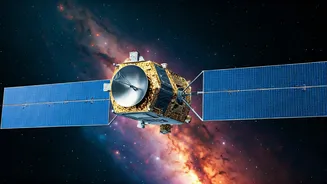
Remember Mangalyaan, India’s celebrated Mars Orbiter Mission? After an incredible eight-year journey—far exceeding its planned six-month lifespan—ISRO officially declared the mission over. Contact was lost after the spacecraft entered a long eclipse,
likely exhausting its fuel and battery power. Launched in 2013, Mangalyaan made India the first nation to reach Martian orbit on its first attempt, a stunning achievement celebrated globally. It studied the Martian atmosphere, discovered suprathermal argon, and gave us incredible insights into dust storms on the Red Planet, all while being one of the most cost-effective interplanetary missions ever.
Chandrayaan-3's Next-Level Engineering
Chandrayaan-3's historic landing near the lunar south pole wasn't just a win; it was an engineering masterclass. What’s gone viral is the mission's design philosophy: engineering for failure. Instead of just trying to prevent every possible error, ISRO designed the Vikram lander with enhanced fault tolerance, meaning it could handle unexpected issues and still land safely. This resilience is seen as a powerful lesson for future deep-space missions. While the solar-powered lander and rover completed their 14-day mission, ISRO is already working with the Department of Atomic Energy to develop a new lunar lander that could survive the freezing lunar night for up to 200 days using an advanced artificial heating system.
India's 'Eye in the Sky' to Watch Space Junk
Did you know there’s a traffic jam in space? To protect its fleet of over 50 satellites, ISRO initiated Project NETRA (Network for space object TRacking and Analysis). This is India's very own early warning system to track debris and other hazards. With a budget of ₹400 crore, NETRA can spot objects as small as 10 cm up to a range of 3,400 km. This system gives India independent space situational awareness (SSA), reducing reliance on data from other countries and enhancing national security. It's a critical step as India plans for zero-debris space missions by 2030.
Gaganyaan Astronauts and Their Intense Training
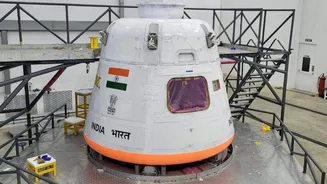
As India prepares for its first human spaceflight mission, Gaganyaan, the rigorous training of the four chosen astronauts has captured public imagination. The designated crew, all Indian Air Force pilots, are undergoing mission-specific training in Bengaluru. Their schedule is packed with everything from academic courses and simulator training to microgravity familiarisation on parabolic flights, survival exercises, and even yoga. This intense preparation is crucial for the mission, which aims to send a crew of three into a 400 km orbit for three days before a safe return to Earth.
Aditya-L1 Is Unlocking Solar Secrets
India's first solar observatory, Aditya-L1, is already making waves. Successfully placed at Lagrange Point 1, about 1.5 million km from Earth, it has an uninterrupted view of the Sun. The mission is providing crucial data on solar storms and space weather, which can impact our satellites and power grids. Aditya-L1 has already sent back over 27 TB of data, which is now available to scientists globally, reinforcing India's position as a key player in international solar research.
Next Stop, Venus! The Shukrayaan Mission
After the Moon and Mars, ISRO has its sights set on Venus with the Shukrayaan-1 mission. Planned for a 2028 launch, this orbiter will study the dense, toxic atmosphere and volcanic activity of Earth's "twin" planet to understand why it became so inhospitable. Key objectives include analysing the sulfuric acid clouds and the super-rotating atmosphere. The mission will involve international collaboration and marks another bold step in India's deep-space exploration journey.