




Our Cosmic Measuring Stick
To understand this cosmic time travel, we first need to grasp the sheer scale of the universe. Light is the fastest thing there is, zipping through the vacuum of space at nearly 3,00,000 kilometres per second. But even at that blistering pace, the distances
between celestial objects are so immense that it takes a significant amount of time for their light to reach us. Astronomers use a unit called a 'light-year' to measure these vast distances. It’s not a measure of time, but of distance: specifically, the distance light travels in one year, which is roughly 9.5 trillion kilometres. This convenient unit does double duty, telling us not only how far away something is, but also how long its light has been travelling to get to us. In essence, looking at an object one light-year away means we are seeing it as it was one year ago.
A Peek into the Recent Past
Let’s start close to home. The light from our own Sun takes about 8 minutes and 20 seconds to reach Earth. This means if the Sun were to suddenly vanish, we would remain blissfully unaware for over eight minutes, basking in its phantom light. Our next nearest stellar neighbour, Proxima Centauri, is about 4.2 light-years away. The faint reddish light we see from it tonight actually left the star more than four years ago. Think about what you were doing back then; that’s when the photons beginning their long journey towards your eyes departed. Every star in the sky, besides our Sun, is at least that old. This is the first step in realising the night sky is a gallery of historical portraits, not a live feed.
Witnessing History Among the Stars
As we look at more distant, familiar stars, the time delay becomes even more dramatic. Take Polaris, the North Star. It’s a reliable beacon for navigation, but its light is far from current. Polaris is approximately 323 light-years away. The light we see from it tonight began its journey around the time the Taj Mahal's construction was being completed. We are seeing a star as it shone during the height of the Mughal Empire. Another famous star, the red supergiant Betelgeuse in the constellation Orion, is roughly 550 light-years from us. The light reaching our eyes now left Betelgeuse when the Lodhi dynasty ruled the Delhi Sultanate. Astronomers believe Betelgeuse is nearing the end of its life and could explode in a supernova anytime in the next 1,00,000 years. For all we know, it might have already exploded 200 years ago, and we are still waiting for the news to arrive at the speed of light.
Looking Back Millions of Years
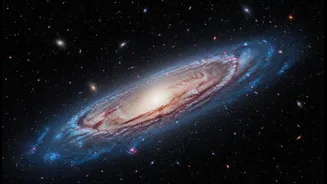
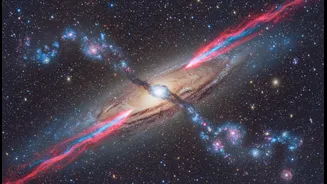
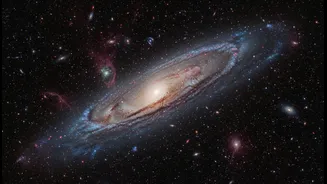
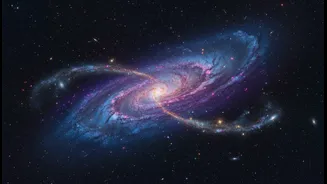
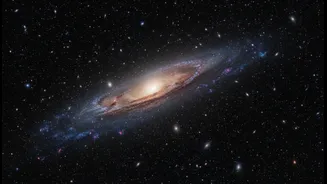
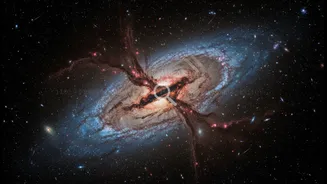
The real mind-bending perspective shift happens when we look beyond our own galaxy. On a clear, dark night, far from city lights, you might be able to spot a faint, fuzzy patch in the sky. This is the Andromeda Galaxy, our closest major galactic neighbour. It is the most distant object visible to the naked eye, and it is a staggering 2.5 million light-years away. The photons of light hitting your retina from Andromeda tonight began their journey before modern humans, *Homo sapiens*, even existed. When that light left, our early ancestors like *Homo habilis* were walking the Earth. You are literally seeing a prehistoric scene, a snapshot of a galaxy as it was when the story of humanity was just beginning.
The Oldest Light in the Universe
Professional telescopes like the Hubble and the James Webb Space Telescope are powerful time machines, built to peer even deeper into the past. They can capture light from galaxies that are billions of light-years away, showing us what the universe looked like in its infancy. But the oldest light we can possibly detect is something else entirely. It’s called the Cosmic Microwave Background (CMB). This is not the light from a star or galaxy but the faint, residual heat left over from the Big Bang itself. This ancient radiation permeates the entire universe, and it has been travelling for approximately 13.8 billion years—the age of the universe itself. When we map the CMB, we are looking at the 'baby picture' of the cosmos.