
A Star's Grand Finale
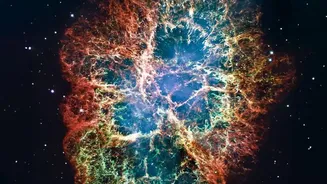
First, let's clear up a common misconception. Despite its name, a "planetary nebula" has nothing to do with planets. It's the elaborate, glowing shroud of gas and dust ejected by a star like our sun at the end of its life. For billions of years, the star fuses
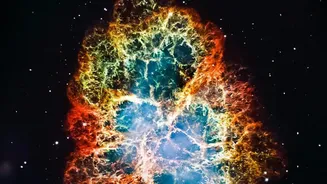
hydrogen into helium. When that fuel runs out, its core collapses into a super-dense, hot remnant called a white dwarf, while its outer layers drift away into space. The intense ultraviolet radiation from the leftover white dwarf then illuminates these expanding shells of gas, creating the spectacular celestial structures we can observe. The Helix Nebula, located about 650 light-years away in the constellation Aquarius, is one of the closest and most striking examples of this process, making it a prime target for astronomers.
Seeing the Helix Nebula in a New Light
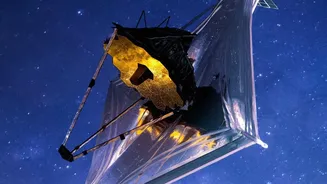
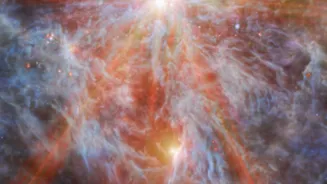
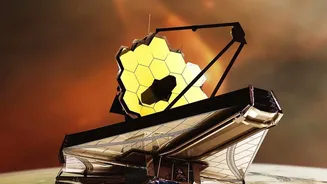
While telescopes like Hubble have studied the Helix Nebula for years, the James Webb Space Telescope's powerful infrared instruments offer an unprecedented view. Infrared light allows us to peer through obscuring dust and see the intricate details of the nebula's structure with stunning clarity. Webb’s new image reveals the stark transition from the hottest gas, closest to the central star, to the coolest gas and dust farther out. It’s like looking at a cosmic weather map where different colors represent different temperatures and chemical compositions. The blistering winds of hot gas rushing from the central star crash into cooler gas that was shed thousands of years prior, sculpting the entire nebula. This celestial collision is what gives the Helix its complex, filamentary appearance.
The Mystery of the Cometary Knots
Perhaps the most fascinating features Webb has brought into focus are the thousands of so-called "cometary knots." These are not actual comets, but gigantic, tadpole-shaped clumps of gas and dust that, until recently, were not fully understood. Each knot has a dense head that can be larger than our entire solar system and a gossamer tail that can stretch for 100 billion miles. They are thought to form when the hot, fast stellar wind from the central star slams into the colder, denser gas ejected earlier. The dense clumps resist being blown away, while the material behind them is swept back, creating long, flowing tails that all point away from the star at the nebula's heart. Webb's observations help confirm that these knots are dense pockets of molecular gas, essentially acting as protective nurseries where dust can form and survive the harsh radiation.
A Glimpse into Our Solar System's Future
Studying the Helix Nebula isn't just an exercise in cosmic sightseeing; it's a preview of our own solar system's distant fate. In about five billion years, our sun will exhaust its hydrogen fuel and begin its transformation into a red giant before puffing its outer layers away to form its own planetary nebula. The remaining core will become a white dwarf, illuminating the ghostly remnants of what was once its atmosphere. The material cast off from dying stars like this, full of heavier elements forged over billions of years, doesn't just disappear. It enriches the interstellar medium, providing the raw ingredients for the next generation of stars and planets. So, when Webb looks at the Helix Nebula, it is not only seeing the end of one star’s life but also the very beginning of countless others.