





What Are Lunar Lava Tubes?
Billions of years ago, the Moon was a hotbed of volcanic activity. Rivers of molten rock flowed across its surface. As the top layer of this lava cooled and hardened, the molten rock below continued to flow, eventually draining away to leave behind vast,
hollow tunnels. These are lava tubes. On Earth, similar formations exist in places like Hawaii and Iceland, but on the Moon, the lower gravity allowed them to form on a colossal scale. Scientists estimate some lunar tubes could be hundreds of meters wide—large enough to house entire cities—and stretch for many kilometers. For decades, their existence was theoretical, but thanks to orbiters like NASA's Lunar Reconnaissance Orbiter (LRO), we've identified hundreds of pits on the surface that are likely 'skylights' where the roof of a lava tube has collapsed, giving us a tantalizing peek inside.
A Natural Shield in a Hostile World
The lunar surface is incredibly dangerous for long-term human settlement. With no atmosphere, it is constantly bombarded with galactic cosmic rays and intense solar radiation, which can cause severe health problems for astronauts. It's also pelted by micrometeorites traveling at immense speeds. Building habitats on the surface that can withstand these threats would require shipping enormous amounts of heavy shielding material from Earth, a costly and complex challenge. Lava tubes offer a natural, ready-made solution. The thick rock ceilings, potentially 100 meters or more, provide superb protection. Studies suggest that sheltering within a lava tube could reduce an astronaut's radiation exposure to levels similar to those experienced on Earth. Furthermore, the tubes offer a stable thermal environment, protecting inhabitants from the Moon's extreme temperature swings, which can range from a scorching 127°C in the day to a frigid -173°C at night.
The Robotic Pioneers Paving the Way
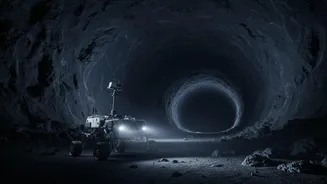
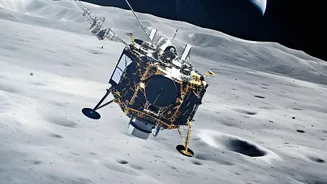
While no human or rover has ventured deep inside these caverns just yet, the headline's spirit of robotic exploration is very much alive. The exploration has begun not by driving in, but by peering from above and planning the first descent. Orbiters have used radar and high-resolution cameras to confirm that these pits are not just craters, but true entrances to subterranean systems. Inspired by these discoveries, several innovative robotic missions are now in development. One concept funded by NASA, the Lunar Underground eXplorer (LUX), proposes using a laser-powered hovering drone that would be lowered into a pit on a fiber-optic tether from a surface rover. This would allow it to explore and create 3D maps without needing a bulky battery. European researchers have also tested a multi-robot system in lava tubes on Earth, using a team of autonomous rovers to map entrances, lower a scout into a pit, and explore the interior. These pioneering concepts are the crucial next step in turning these promising locations into viable sites for a future lunar base.
Designing a Subterranean Moon Base
What would a home inside a lunar lava tube actually look like? Engineers and architects are already conceptualizing these outposts. Rather than building from scratch, the strategy would be to use the lava tube as a protective outer shell. Inside these vast, stable caverns, astronauts could deploy lightweight, inflatable habitats. These structures wouldn't need heavy radiation shielding, so a much larger portion of the landed mass could be dedicated to scientific equipment and life support systems. Researchers at the University of Arizona have designed concepts for entire command centers, data hubs, and refuges nestled within the tubes. Challenges remain, of course. Power would need to be generated on the surface with solar panels and beamed down, and systems for raising and lowering people and equipment would be essential. But by using the Moon's own geology, we can bypass some of the greatest obstacles to establishing a permanent human presence.