

The Sun’s Burning Question
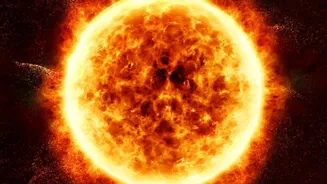
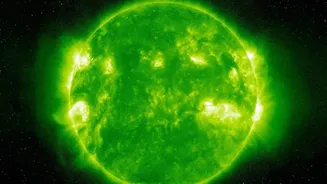
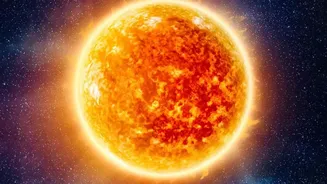
For nearly a century, solar physicists have been puzzled by the coronal heating problem. The Sun's visible surface, the photosphere, sizzles at around 5,500 degrees Celsius. Logic would suggest that as you move away from this heat source, the temperature
should drop. Yet, the Sun's wispy outer atmosphere, the corona, blazes at an incredible one to two million degrees Celsius. This defies the basic laws of thermodynamics, which state that heat cannot flow from a cooler body to a hotter one. It’s like standing near a campfire and feeling the air get exponentially hotter the further you walk away. To explain this, scientists have long theorised that some non-thermal process must be carrying energy from the Sun's interior and depositing it into the corona. The primary suspects have always involved the Sun's powerful and complex magnetic fields.
A Wave of New Evidence
Two main theories have dominated the debate: one involves countless tiny explosions called 'nanoflares' peppering the corona with heat, and the other involves magnetic waves transporting energy upwards. Recently, attention has focused intensely on a specific type of magnetic wave called an Alfvén wave. Predicted by Hannes Alfvén in the 1940s, these waves are vibrations that travel along magnetic field lines, like a pluck on a guitar string. Recent observations, particularly from powerful new instruments like the Daniel K. Inouye Solar Telescope in Hawaii, have provided the most detailed look ever at the Sun's surface and atmosphere. Within the last couple of years, scientists have confirmed the existence of elusive, twisting 'torsional' Alfvén waves, which had been sought for decades. These, along with other newly observed high-frequency waves, appear to carry significant energy into the corona.
How Waves Heat the Corona
Observing the waves is one thing; understanding how they release their energy as heat is another. The latest discoveries suggest several powerful mechanisms. One key finding involves wave reflection. As Alfvén waves travel from the Sun's surface into the less dense corona, they can encounter regions of varying plasma density that cause them to reflect backwards. The collision of these outgoing and reflected waves creates turbulence, which dissipates as heat. Laboratory experiments have successfully demonstrated this process, showing it could be responsible for the high temperatures seen in coronal holes—areas where the Sun’s magnetic field lines extend far into space. Another process is the transformation of one wave type into another. As these waves travel upwards, they can transmute into different kinds of waves that then dissipate into shockwaves, releasing their energy in the corona.
Putting the Pieces Together
The latest observations from missions like the Solar Orbiter and the Daniel K. Inouye Solar Telescope are helping scientists connect small-scale events on the Sun's surface to the large-scale heating of the atmosphere. For instance, high-resolution images have revealed tiny, swirling vortices on the solar surface, barely a few dozen kilometres wide. These 'whirlpools' are thought to be motors that twist the magnetic field, generating the very waves that travel upwards. This provides a direct link between the churning motions of the Sun's surface, the generation of magnetic waves, and the eventual heating of the corona millions of kilometres above. It appears that not just one, but a combination of wave-related processes, are responsible for solving the heating puzzle.
Why This Solar Mystery Matters
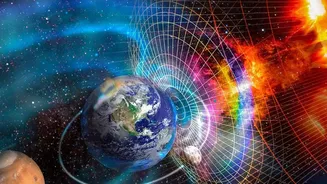
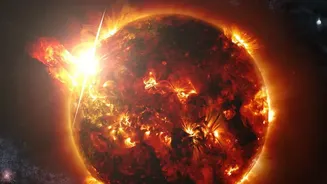
Understanding the corona is not just an academic exercise. The same processes that heat the corona also drive the solar wind, a constant stream of charged particles that flows from the Sun and envelops the entire solar system. Violent solar events, such as solar flares and coronal mass ejections (CMEs), are also powered by the Sun's magnetic energy. These events can trigger 'space weather' storms that have the potential to disrupt our satellites, knock out power grids, and interfere with GPS and communication systems on Earth. By better understanding the fundamental physics of how the Sun transfers energy, scientists can improve their models for predicting space weather, giving us a better chance to protect our critical infrastructure.