



A Billion-Dollar Bet on Touch
The $150 million funding round, co-led by Andreessen Horowitz and F-Prime, catapults Eka Robotics to a valuation of over $1 billion. This significant investment underscores a growing consensus among investors: the next leap in automation isn't about making
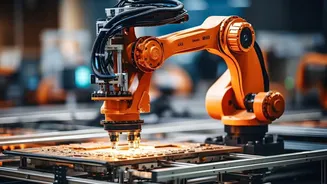
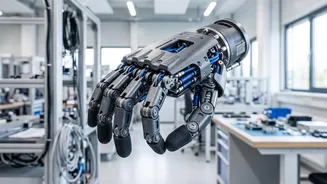
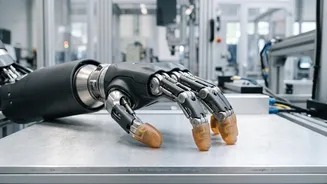
robots stronger or faster, but more sensitive. For decades, industrial robots have excelled at repetitive, brute-force tasks like welding or lifting heavy parts on an assembly line. But ask a robot to perform a task requiring finesse—like plugging in a delicate cable, sorting mixed fruits, or handling fragile electronics—and its limitations become clear. Eka's mission is to bridge this gap by giving robots a sense of touch, an ability that has so far remained distinctly human.
The Clumsy Hand Problem
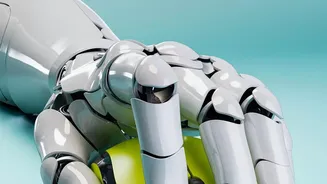
In robotics, there's a concept known as Moravec's Paradox, which states that tasks easy for humans are often incredibly difficult for robots, and vice versa. A robot can perform complex calculations in a nanosecond but struggles with the simple act of picking up a set of keys. This is the 'dexterity deficit'. Human hands don't just see an object; they feel its texture, weight, and fragility, constantly adjusting grip pressure in real-time. Most robots, by contrast, operate on pre-programmed instructions, relying almost entirely on vision. They lack the rich, tactile feedback that makes human manipulation so effortless and adaptable. This limitation has prevented automation from entering countless industries where tasks are too complex and variable for rigid programming.
Eka's Software-First Solution
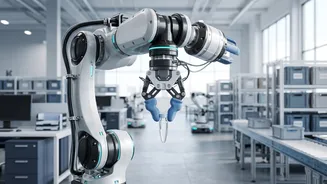
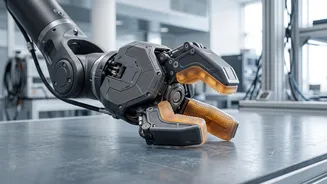
Instead of building entirely new robots, Eka has developed an AI model it calls 'Vision-Force-Action' (VFA). This system combines traditional computer vision with crucial data from force sensors embedded in the robot's gripper. This allows the robot to 'feel' when an object is slipping or if a connector is meeting resistance, and then adjust its actions accordingly. The 'brain' behind this is trained not by watching humans, but through thousands of hours of trial-and-error in a hyper-realistic physics simulator. This reinforcement learning approach allows Eka to generate vast amounts of experience in minutes, teaching the AI to handle a wide variety of objects and situations it has never physically encountered before.
From Warehouses to Data Centres
So what does 'real work' for a dexterous robot look like? The applications are vast. In e-commerce warehouses, it means robots capable of picking and packing a diverse range of products from a single bin, a task that currently relies heavily on human workers. In electronics assembly, it means handling and connecting tiny, delicate components with precision. Eka's technology could also be applied to data centre maintenance, where robots could manage dense racks of cables and connectors, or even in food processing for tasks like sorting produce without causing damage. The company reports its system can already pick objects at a rate of 1,500 per hour with over 95% reliability in lab settings—more than double the speed of a human worker.
What Comes After Series A?
Raising a Series A of this magnitude marks a new chapter for Eka. The focus now shifts from research and development to commercial deployment and scale. The fresh capital will be used to expand its engineering teams and begin rolling out customer pilots in sectors like manufacturing and logistics. The challenge will be to prove that the impressive performance seen in the lab can be sustained reliably on real factory floors and in busy warehouses, operating 24/7. Hardware durability and seamless integration with existing industrial systems will be critical hurdles to overcome. Success would not just validate Eka's technology but could fundamentally change the economics of labour in numerous industries.