









More Than Just a Tech Update
Unlike previous technological waves, the current AI revolution, powered by generative models like GPT-4 and others, isn't just automating repetitive tasks. It's capable of generating new content, writing code, designing marketing copy, and even analysing
complex datasets. This shift from automation to generation is what makes it so disruptive. In India's booming services and IT sectors, this means that roles once considered safe—those requiring cognitive and creative labour—are now being augmented, and in some cases, redefined by AI. The question is no longer *if* AI will impact your job, but *how* you will leverage it to stay ahead.
The AI Co-pilot: Augmentation Over Replacement
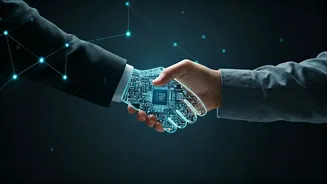
The dominant narrative often paints a grim picture of mass job replacement. However, a more nuanced reality is emerging. According to reports from firms like McKinsey and the World Economic Forum, AI is more likely to act as a 'co-pilot,' augmenting human capabilities rather than replacing them entirely. Think of a marketer using AI to generate ten headline ideas in seconds, then using their expertise to pick the best one. Or a developer using an AI assistant to write boilerplate code, freeing them up to focus on complex architectural problems. The most valuable professionals will be those who can effectively partner with AI, using it to amplify their own skills and productivity. The threat isn't AI itself, but a workforce that is unwilling or unable to adapt to working alongside it.
The New Skill Imperative: What to Learn Now
So, what does 'upskilling' in the age of AI actually mean? It’s a blend of technical fluency and uniquely human abilities. The focus should be on building a durable, future-proof skillset. First, develop AI Literacy and Prompt Engineering. You don't need to become an AI researcher, but you must understand how these tools work. Learning how to write effective prompts—the instructions you give to an AI—is quickly becoming a critical skill, akin to learning how to use a search engine effectively a decade ago. Second, double down on Data Analysis and Digital Fluency. AI runs on data. Professionals who can interpret data, understand analytics, and use digital tools to make informed decisions will be indispensable. This applies to roles far beyond IT, including marketing, finance, and HR. Finally, and perhaps most importantly, cultivate Human-Centric Skills. As AI handles more routine cognitive tasks, abilities like critical thinking, complex problem-solving, creativity, emotional intelligence, and strategic communication become more valuable than ever. These are the areas where humans still hold a distinct advantage. AI can generate a report, but it takes a human to persuade a skeptical board to act on it.
Your Practical Upskilling Roadmap
Feeling overwhelmed? Don't be. Building these skills is a marathon, not a sprint. Start small but be consistent. 1. Embrace Micro-Learning: Dedicate 30-60 minutes each day or week to learning. Use online platforms like Coursera, edX, or India-specific portals like NPTEL to take short courses on AI fundamentals, data basics, or digital marketing. 2. Learn by Doing: The best way to learn is by applying. Start a small project. Use a generative AI tool to help you brainstorm a business idea. Build a simple data dashboard using a free tool. Use AI to help you write a blog post on a topic you know well. Practical application solidifies knowledge far better than passive consumption. 3. Follow the Experts: Identify and follow credible voices in the AI space on platforms like LinkedIn and Twitter. Their insights can help you stay updated on the latest trends and tools without having to sift through mountains of information. 4. Seek Company-Sponsored Training: Many large Indian corporations are heavily investing in upskilling their workforce. Inquire about internal training programs, workshops, and resources available to you. Proactively showing interest in your own development is a powerful career move.