
Your Guide to Spotting the 'Evening Star'
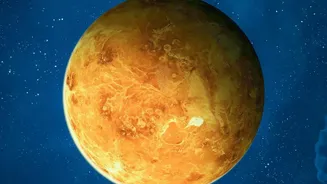
Throughout August 2026, Venus is dominating the early evening sky, shining brighter than any actual star. Often called the 'Evening Star' for its habit of appearing around dusk, this month it is exceptionally bright and easy to spot, even from light-polluted
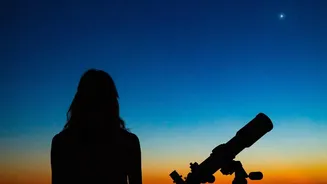
cities. Unlike stars that twinkle, Venus glows with a steady, silvery light, making it a captivating target for even the most casual sky-watcher. You don't need any special equipment to see it; just your own eyes and a clear view of the western horizon are enough to enjoy this celestial treat. The key is knowing exactly when and where to direct your gaze as the sun goes down.
The Best Time to Look
Timing is everything when it comes to spotting Venus. The best window for viewing is in the 30 to 90 minutes immediately following sunset. As the sky transitions from deep blue to inky black, Venus will pop into view as a stunningly bright point of light. If you look too early, the sun's remaining glare will wash it out. If you wait too long, the planet will have dipped below the horizon. For most of India, Venus will be visible until around 9:00 PM or 9:30 PM this month. Find a comfortable spot with an unobstructed view to the west, let your eyes adjust to the gathering dark for a few minutes, and be patient. The show is well worth the wait.
Pinpointing Its Location: West-Southwest
To find Venus, you'll want to face the direction where the sun just set. Throughout August, the planet will be positioned in the west-southwest. It won’t be directly overhead but will hang relatively low above the horizon. A great way to orient yourself is by using a simple compass or a compass app on your phone. As the month progresses, you can watch Venus slowly make its way through the constellation Virgo, the Maiden. It will also be closing in on Virgo’s brightest star, Spica, setting up a beautiful conjunction in early September. Using Spica as a reference point can help you track Venus's movement from night to night.
What to Look For (and What It’s Not)
When you scan the western sky, Venus will be unmistakable. It is the brightest object in that part of the sky after the sun sets. The main giveaway is its steady, unwavering light. Stars, which are immensely distant suns, appear as tiny points of light that are easily disturbed by Earth's atmosphere, causing them to twinkle. Planets like Venus are much closer and their light comes from a small disk, which makes them appear as solid, non-twinkling orbs. If you see a light that is moving steadily across the sky, it's likely a satellite or an airplane. Venus will appear stationary against the backdrop of stars during your viewing session.
A Celestial Meetup with the Moon
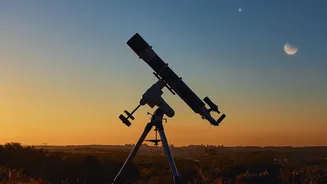
For an extra special sight, mark your calendar for the evenings around August 15th and 16th. During this time, a slender waxing crescent Moon will pass close to Venus, creating a stunningly beautiful pairing in the twilight sky. These conjunctions are fantastic photo opportunities and make finding Venus even easier—just look for the Moon, and the brilliant beacon nearby will be Venus. The faint glow of 'earthshine' might even be visible on the dark portion of the crescent Moon, adding another layer of beauty to the scene.
Do You Need a Telescope?
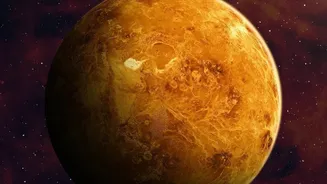
Absolutely not! Venus is one of the five 'naked-eye' planets and its brilliance this month makes it impossible to miss. However, if you happen to have a pair of binoculars or a small telescope, you’ll be in for an additional treat. A telescope will reveal that Venus goes through phases, just like our Moon. Around the middle of August, it will appear as a tiny, half-lit moon. As the month wears on and Venus gets closer to Earth in its orbit, its apparent size will grow while its illuminated phase shrinks to a beautiful crescent. It's a fascinating way to witness the mechanics of our solar system from your own backyard.