
Why Holding Poses Builds a Stronger Core
When you hold a yoga pose, you're performing an isometric contraction, where your muscles are engaged without changing their length. This sustained effort is fantastic for building muscular endurance and stability. Unlike dynamic exercises, holding poses
allows you time to focus on proper alignment and deepen the engagement of your core muscles—which include not just your abs, but also your back, pelvic floor, and diaphragm. This approach builds functional strength that supports you in daily activities, improves posture, and can even help alleviate back pain. The key is consistency and mindful breathing, which helps keep the core engaged throughout the hold.
Plank Pose (Phalakasana)
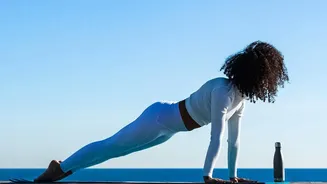
The Plank is a fundamental pose for total-body core activation. It strengthens the front of your abdomen, shoulders, and glutes all at once. To perform it, start on your hands and knees, then step your feet back until your body forms a straight line from your head to your heels. Your wrists should be directly under your shoulders. Actively press the floor away, pull your belly button towards your spine, and squeeze your thigh muscles to keep your body rigid. Avoid letting your hips sag or rise too high. Hold for 30 seconds, focusing on steady breaths. For a gentler variation, you can lower your knees to the mat.
Boat Pose (Navasana)
If you've ever felt your abs shake in a yoga class, you were likely in Boat Pose. This pose directly targets the abdominal muscles while also challenging your balance. Start seated with your knees bent and feet flat on the floor. Place your hands behind you for support as you lean back slightly, lifting your shins parallel to the floor. Engage your core to keep your back straight and chest lifted. For a greater challenge, straighten your legs and extend your arms forward, parallel to the floor, creating a 'V' shape with your body. Hold for five deep breaths, building up your time as you get stronger.
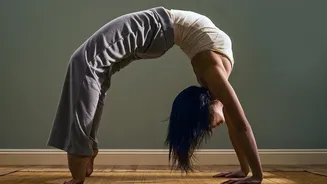
Bridge Pose (Setu Bandhasana)
Bridge Pose is excellent for strengthening the posterior part of your core, including your glutes and lower back, which are essential for overall stability. Lie on your back with your knees bent, feet flat on the floor hip-width apart, and arms alongside your body with palms down. Press into your feet and lift your hips off the floor. Keep your thighs parallel and distribute your weight evenly. This pose opens the chest while engaging the back body. Hold for 30-60 seconds, continuing to breathe deeply. This pose can be both energising and restorative while building foundational strength.
Bird-Dog Pose (Dandayamana Bharmanasana)
This beginner-friendly pose is exceptional for building core stability because it trains your body to resist rotation and maintain balance. Start on all fours with your wrists under your shoulders and knees under your hips. Engage your core to keep your back flat. Extend your right arm straight forward and your left leg straight back simultaneously. Hold for a few seconds, ensuring your hips and shoulders remain level. Return to the starting position with control and repeat on the other side, extending your left arm and right leg. This trains the deep stabilizing muscles of your abdomen and back.
Chair Pose (Utkatasana)
Chair Pose is a powerful standing posture that builds heat and strengthens the core, glutes, and thighs. Stand with your feet together or hip-width apart. Inhale and raise your arms overhead. As you exhale, bend your knees and sink your hips back and down, as if sitting in an imaginary chair. Your core has to work continuously to stabilize your spine and prevent your lower back from arching excessively. Keep your weight in your heels and your chest lifted. If holding your arms overhead is too intense, you can extend them forward at shoulder height instead. Hold the pose for 30 seconds, feeling the engagement in your lower abs.