

An Eye That Never Blinks
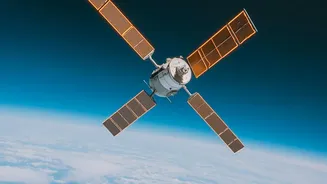
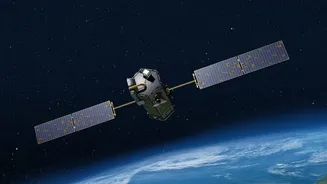
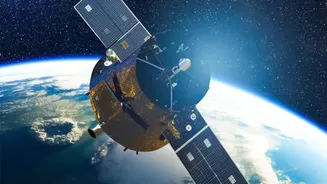
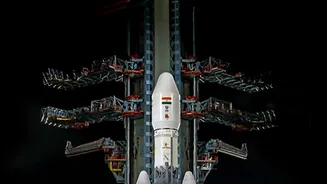
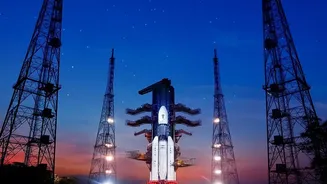
The Indian Space Research Organisation (ISRO) is gearing up for a significant launch: GISAT-1A, also known as EOS-05. This is not just any satellite. It is a state-of-the-art Geo-Imaging Satellite designed to be India's sentinel in the sky. Its primary
mission is to provide near real-time, high-resolution images of the Indian subcontinent. Unlike other remote sensing satellites that orbit the poles and see a particular spot on Earth only briefly each day, GISAT-1A will have a continuous watch. This capability is a game-changer for everything from national security to disaster management, allowing for rapid monitoring of floods, cyclones, and forest fires.
The Geostationary Advantage
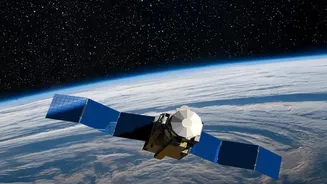
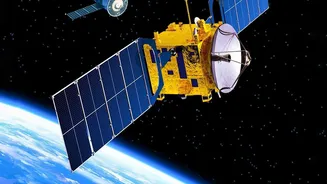
The secret to GISAT-1A's constant vigil is its orbit. It will be placed in a geostationary orbit, approximately 36,000 kilometres above the equator. At this specific altitude, a satellite's orbital period matches the Earth's rotation exactly—23 hours, 56 minutes, and 4 seconds. The result is that the satellite appears to hover motionless over a fixed point on the ground. This unique perch allows GISAT-1A to image the entire Indian landmass every half hour and focus on specific areas of interest every five minutes. It's like having a camera mounted on an incredibly tall, invisible pole, always pointed at home.
Seeing the Unseen: Hyperspectral Imaging
The true magic of GISAT-1A lies in its advanced imaging payloads. The satellite is equipped with powerful multi-spectral and hyperspectral cameras. While a normal camera sees light in three bands (red, green, and blue), a hyperspectral imager divides light into hundreds of narrow bands, extending beyond what the human eye can perceive. This creates a unique "spectral fingerprint" for every pixel in the image. This technology allows scientists to identify specific materials and conditions on the ground with incredible accuracy. It can be used to detect mineral deposits, assess crop health and stress, identify different types of vegetation, and even spot pollution in water bodies.
A Story of Resilience
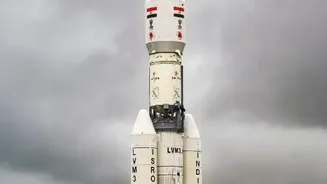
The journey to GISAT-1A has not been without challenges. The mission is, in essence, a second attempt. Its predecessor, GISAT-1 (also known as EOS-03), was lost during its launch in August 2021. The GSLV rocket carrying the satellite performed normally in its initial stages, but a technical anomaly prevented the third-stage cryogenic engine from igniting. A failure analysis committee identified a pressure loss in the liquid hydrogen tank as the root cause. The upcoming launch of GISAT-1A, scheduled for early September 2026, is therefore seen as a redemption mission for ISRO, demonstrating its perseverance and commitment to overcoming setbacks. The new satellite is not just a replacement; it incorporates several improvements over the original.
What It Means for India
The capabilities of GISAT-1A have profound implications for India. In an era of climate change, its ability to provide early warnings for cyclones and track the progression of floods and droughts is invaluable for disaster management. For agriculture, it can offer insights into crop health, soil moisture, and nutrient deficiencies, supporting precision farming and boosting yields. Furthermore, its constant surveillance capabilities are of immense strategic importance, enhancing border monitoring and aiding security forces. The 2.2-tonne class satellite will significantly strengthen India's Earth observation infrastructure, ensuring it has the data needed to manage its resources, protect its environment, and safeguard its interests.