





Lighthouses of the Early Universe
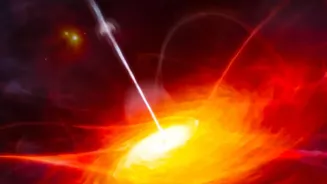
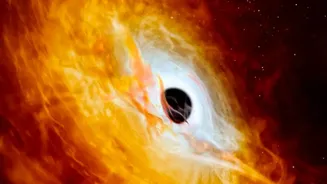
Before we get to the twins, let's talk about what a quasar is. Short for 'quasi-stellar object', a quasar is one of the most luminous and energetic things in the entire cosmos. They are not stars, but the intensely bright cores of distant galaxies. At
the heart of a quasar is a supermassive black hole, millions or even billions of times the mass of our sun. As this behemoth greedily pulls in surrounding gas and dust, the material forms a swirling, superheated disc. This 'accretion disc' gets so hot and agitated that it can outshine all the billions of stars in its own galaxy combined, making it visible across billions of light-years. This is why astronomers use them as beacons to study the conditions of the very early universe.
A Record-Breaking Pair
Finding a quasar from the cosmic dawn—the period just after the first stars ignited—is rare and exciting. Finding two of them practically side-by-side is unprecedented. A team of astronomers using JWST and the Gemini North telescope in Hawai'i confirmed the discovery of J1602+4228AB, a pair of quasars seen as they were just 900 million years after the Big Bang. They are separated by only 18,100 light-years, which sounds vast, but is incredibly close on a cosmic scale—well within the span of our own Milky Way galaxy. This makes them the most distant and compact quasar pair ever identified from this ancient era. The discovery even earned a Hawaiian nickname, Nāpōwawāʻenakaulua, meaning 'Two celestial bodies of fathomless powerful darkness'.
Why This Discovery Changes Everything
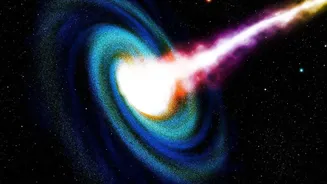
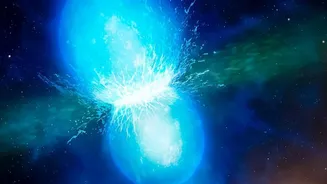
So, why is finding a pair so important? A single supermassive black hole from this early epoch is already a puzzle for scientists. According to current models of the universe, there simply shouldn't have been enough time for a black hole to grow so massive, so quickly after the Big Bang. Now, astronomers have found two of these 'impossible' objects together. This strongly suggests that we are witnessing the result of a colossal galaxy merger happening much earlier than predicted. The gravitational chaos of two galaxies colliding would funnel enormous amounts of gas toward their central black holes, causing both to light up as quasars simultaneously. This pair isn't just a coincidence; it's a snapshot of how the first massive structures in the universe may have been built.
The Power of Webb and Gemini
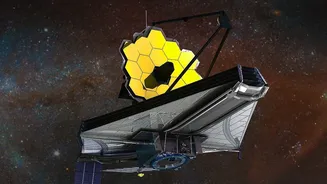
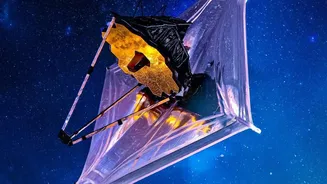
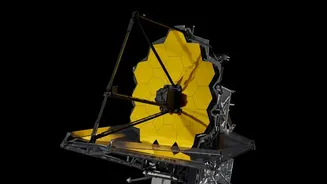
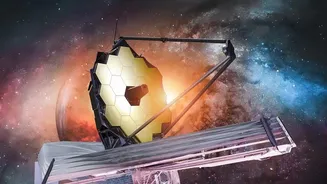
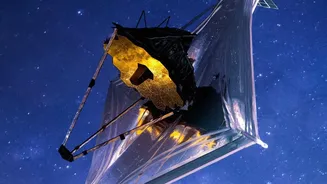
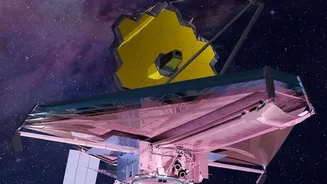
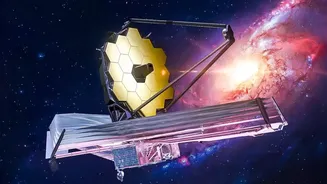
Spotting this duo was a remarkable feat of observation. The pair was first identified in data from a JWST survey called Aether, which is building a census of early universe objects. However, because the two light sources are so close together, astronomers had to be sure they weren't just seeing a single quasar whose light was being split by a gravitational lens—a trick of gravity from a foreground galaxy creating multiple images. To confirm they were truly two separate objects, the team used the powerful Gemini North telescope. The ground-based telescope's sharp vision, combined with Webb's unparalleled sensitivity, allowed them to analyze the light signatures, or spectra, from each quasar individually, confirming they were a genuine physical pair.
Rewriting the Cosmic Story
The existence of Nāpōwawāʻenakaulua forces a rethink of how quickly the early universe got organized. It suggests that the cosmic web of gas and dark matter was dense enough in some places to trigger massive galaxy pile-ups and ignite frantic black hole growth far sooner than models allowed. For decades, the rapid emergence of supermassive black holes has been one of the biggest mysteries in astrophysics. This discovery doesn't solve the mystery, but it provides a crucial new clue: that mergers were a key ingredient. It indicates the universe was a more dynamic and structured place at 900 million years old than we ever imagined, with giant galaxies already crashing together and building the cosmic titans we see in the later universe.