




What Is Cosmic Radiation?
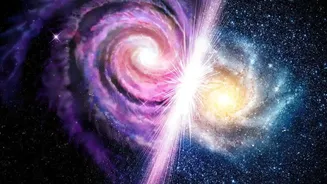
Imagine the universe as a vast, dynamic space filled with explosive events like supernovas and powerful objects like stars and black holes. These events throw off a constant stream of high-energy particles that travel across space at nearly the speed
of light. This stream is called cosmic radiation. When these particles, mostly protons and atomic nuclei, strike Earth's atmosphere, they create a shower of secondary particles that rain down on the surface. We are exposed to this natural radiation every day, though the dose is typically too low to pose a health risk. For scientists, however, this cosmic rain is a treasure trove of information, carrying messages from the most distant and violent corners of the cosmos.
The Hunt for Anomalies
For decades, cosmologists have operated on the 'Standard Model', a framework that brilliantly explains much of the universe. Yet, it has gaps—it doesn't fully account for dark matter, dark energy, or other strange observations. Scientists look for 'anomalies', or signals that don't fit the standard predictions. One such area of intense study is the Cosmic Microwave Background (CMB), the oldest light in the universe, left over from about 380,000 years after the Big Bang. Observations have hinted that the polarization of this ancient light might have slightly rotated during its 14-billion-year journey to us, a potential effect known as 'cosmic birefringence'. This kind of signal could point to new physics, but it's incredibly faint and hard to distinguish from instrumental errors.
The Challenge of a Clean Signal
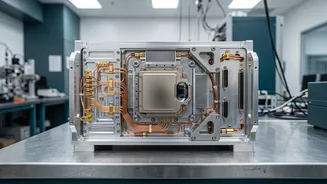
The main problem for researchers is noise. A tiny error in a telescope's calibration can create a false signal that looks almost identical to a real cosmic discovery. Think of trying to hear a whisper in a crowded stadium; it's difficult to know if you really heard something or if it was just a random sound from the crowd. To solve this, researchers need exceptionally precise tools and methods to be sure that what they are 'hearing' from the cosmos is a genuine message and not just static from their own equipment. This is where the latest work from UC San Diego comes in. The university is a hub for cosmological research, with labs dedicated to building and testing ultra-sensitive instruments for telescopes.
A New Method for Verification
A team of physicists at UC San Diego, including Professor Kam Arnold and Professor Brian Keating, recently developed a clever new method to improve the search. Instead of relying on a single, combined measurement from a telescope's detectors, their technique involves comparing separate data maps generated by different groups of detectors on the same instrument. The logic is simple: if a strange signal like cosmic birefringence is real, it should appear consistently across all the independent maps. However, if the signal is just an error from one group of detectors, it will show up as an inconsistency when compared to the others. This cross-checking process allows scientists to effectively cancel out the 'noise' and identify calibration errors with much greater confidence, strengthening the foundation for any potential discovery.
Why This Matters for Future Discoveries
While this new technique does not confirm the existence of cosmic birefringence on its own, it represents a crucial step forward. By providing a more robust way to validate their data, the UC San Diego researchers are sharpening the tools astronomers use to probe the universe. Current and future projects, like the Simons Observatory in Chile where UC San Diego plays a key role, rely on extreme precision to hunt for faint signatures of cosmic inflation and other phenomena from the dawn of time. Better calibration means a higher chance of making a clean detection. Each refinement like this brings us closer to potentially discovering new fundamental physics and answering profound questions about how the universe began and evolved.