


The Tyranny of Distance
The core communication problem between Earth and Mars is the unavoidable delay imposed by the speed of light. Depending on the planets' positions in their orbits, a radio signal can take anywhere from four to 24 minutes to travel one way. This means a simple
question sent from Mission Control could take up to 48 minutes to receive a reply. This isn't a technological bottleneck we can solve with faster computers; it's a fundamental rule of physics. Furthermore, for about two weeks every 26 months, Mars and Earth are on opposite sides of the Sun, creating a communications blackout where radio signals are blocked or distorted. Any mission, whether crewed or robotic, must be designed to operate under this immense, time-lagged shadow.
The Patient, Autonomous Robot
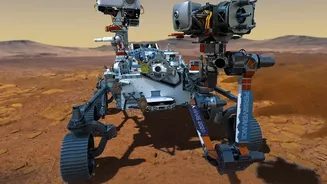
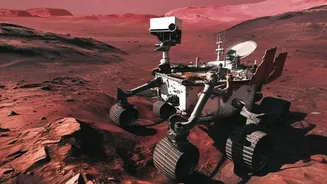
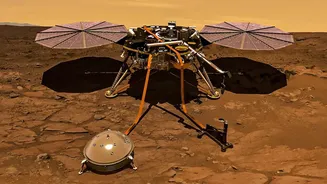
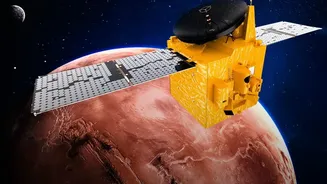
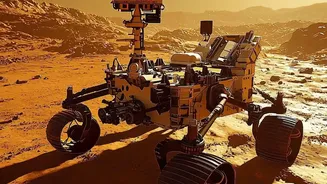
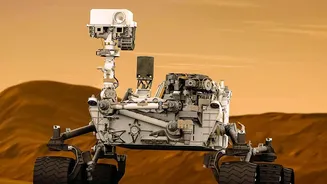
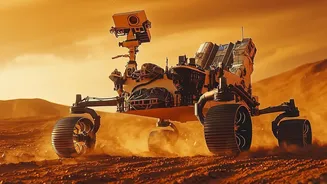
Robotic missions, like NASA's durable rovers Spirit, Opportunity, and Curiosity, are marvels of patience and autonomy, designed specifically to work around this delay. Mission planners don't 'drive' rovers in real time with a joystick. Instead, they upload a carefully planned sequence of commands for the next Martian day, or 'sol'. The rover then executes these instructions on its own, gathering data and navigating obstacles. The collected information is typically relayed to an orbiter, which has a more powerful antenna and can send large data packets back to Earth more efficiently than the rover could directly. This 'store-and-forward' system works well. It allows for incredible scientific discovery, but it's a slow and deliberate process. A rover might spend an entire day executing commands that a human astronaut could complete in minutes.
The Human Factor: A High-Stakes Delay
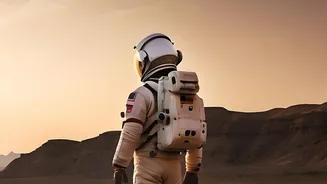
For human explorers, the same communication lag becomes a life-threatening liability. Imagine an astronaut having a medical emergency; a doctor on Earth would be a 40-minute round-trip message away from even seeing the initial symptoms. Routine tasks become fraught with risk, as real-time guidance from Mission Control during an equipment malfunction is impossible. Beyond physical dangers, the psychological toll is immense. The inability to have a normal, flowing conversation with loved ones or mission support can lead to profound feelings of isolation and stress, potentially impacting crew performance and mental health. Unlike robots that can be put in a 'safe mode' during communication blackouts, a human crew would be entirely on their own to solve any crisis that arises during those weeks of solar conjunction.
Bridging the Gap with New Technology
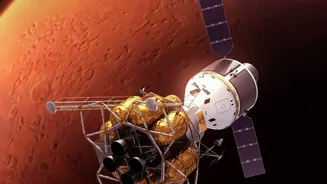
To make human missions feasible, space agencies are developing technologies to mitigate these communication challenges. The most promising is laser, or optical, communication. Instead of radio waves, this method uses infrared light beams to transmit data. Projects like NASA's Laser Communications Relay Demonstration (LCRD) have shown that optical systems can transmit 10 to 100 times more data than current radio frequency (RF) systems. This increased bandwidth could mean sending high-definition video from Mars instead of compressed images, a vital tool for medical and engineering support. While lasers still travel at the speed of light and don't solve the time delay, the higher data rate means more information can be packed into each transmission. To combat blackouts, a network of relay satellites could be placed at strategic points in the solar system, allowing signals to bypass the Sun.
The Verdict: Autonomy is Key
Ultimately, the debate isn't simply about robots versus humans, but about asynchronous versus synchronous work. Robots are masters of operating on a delay, patiently executing commands and sending back data. Humans, however, are wired for real-time interaction and problem-solving. For astronauts to thrive on Mars, they will need unprecedented levels of autonomy. This includes advanced AI to serve as on-site assistants, sophisticated diagnostic systems for equipment and health, and the training to handle any crisis without a call home. Robotic missions have taught us how to explore Mars with a time delay. Human missions will require us to learn how to live with one.