



A Renewed Global Race to a Forgotten Planet
For decades, Venus was largely overlooked in favour of Mars. But that is changing. A fleet of missions from NASA, the European Space Agency, and even private companies are now targeting the second planet from the Sun, and India's Shukrayaan is a key part
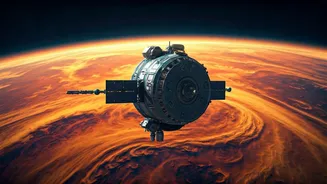
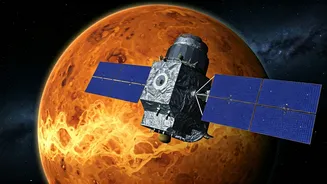
of this global resurgence. The Indian Space Research Organisation (ISRO) is planning to launch its first-ever orbiter to Venus, with a potential launch date set for 2028. Following the historic successes of Chandrayaan-3 and the Mangalyaan Mars mission, Shukrayaan represents the next logical step in India’s interplanetary ambitions. This renewed interest isn't a coincidence; scientists believe Venus, a world that may have once been habitable, holds vital answers to pressing questions about our own planet.
Venus: A Case Study for Climate Change
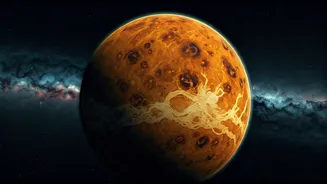
Often called Earth's twin due to their similar size and mass, Venus is anything but hospitable today. Its surface is a scorching landscape with temperatures hot enough to melt lead, crushed by an atmosphere 90 times denser than Earth's. This hellish state is the result of a runaway greenhouse effect, a scenario where the planet's thick carbon dioxide atmosphere traps heat. For Indian scientists, studying this process is a top priority. By understanding how Venus transformed from a potentially water-rich world into its current state, researchers can vastly improve climate models for Earth. It serves as a planetary-scale cautionary tale, offering a natural laboratory to study the long-term consequences of an atmospheric imbalance, a subject of critical importance for our own world.
Unlocking Geological and Atmospheric Secrets
Shukrayaan is not just about climate science. The mission has ambitious goals to map the Venusian surface and subsurface for the first time. Unlike Earth, Venus is shrouded in thick clouds of sulfuric acid, making its surface impossible to see with conventional cameras. ISRO's orbiter will be equipped with advanced instruments like a high-resolution Synthetic Aperture Radar (SAR) and a ground-penetrating radar to peer through the clouds and study the planet's geology, including its volcanic activity and unique surface features. The mission also aims to investigate the mysterious 'super-rotation' of Venus's atmosphere, which whips around the planet in just four Earth days, and how it interacts with the solar wind without the protection of a global magnetic field like Earth's.
A Showcase of Indian Ingenuity and Leadership
Beyond the scientific returns, the Shukrayaan mission is a significant driver of technological innovation and a symbol of India's growing stature in space exploration. Developing a spacecraft and instruments that can survive the harsh journey and environment of Venus pushes ISRO's capabilities to new limits. The mission has already attracted international collaboration, with countries like Sweden and France partnering with ISRO to include their scientific instruments on the orbiter. This collaboration is a testament to the global scientific community's trust in ISRO's cost-effective and highly successful approach to interplanetary missions. Successfully reaching Venus would place India in an elite club of nations that have explored the planet, cementing its role as a leader in deep space exploration.