


More Than Just Pretty Pictures
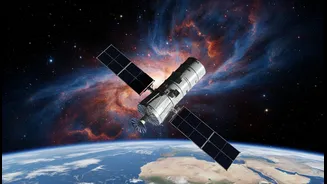
Launched in 1990, the Hubble Space Telescope was designed with a key objective: to measure the size and age of the universe. Positioned above Earth's distorting atmosphere, it offered a clarity no ground-based telescope could match. Its early observations
immediately began to reshape astronomy. Discoveries like proving that supermassive black holes exist at the center of most major galaxies fundamentally changed our understanding of cosmic structure. The telescope also gave us iconic, and scientifically vital, images like the 'Pillars of Creation' in the Eagle Nebula, revealing the chaotic beauty of star formation in unprecedented detail. These early wins set the stage for a mission that would consistently exceed expectations.
Measuring the Universe's Expansion
One of Hubble's most critical tasks was to refine the value of the Hubble Constant, a number that describes how fast the universe is expanding. This figure is key to determining the age and ultimate fate of the cosmos. Edwin Hubble first proposed the concept in 1929, but precise measurements remained elusive. By observing special pulsating stars called Cepheid variables, the space telescope was able to build a 'cosmic distance ladder', stepping from nearby galaxies to more distant ones. This work helped pin down the universe's age to about 13.8 billion years. In the process, however, Hubble's data helped uncover a profound mystery: the universe's expansion is accelerating, driven by an unknown force now called 'dark energy'.
A Glimpse into the Void
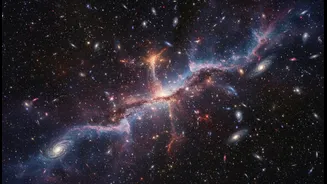
In 1995, astronomers took a gamble. They pointed Hubble at a seemingly empty patch of sky in the constellation Ursa Major for ten consecutive days. The result was the Hubble Deep Field, a landmark image that revealed nearly 3,000 galaxies in a speck of the sky previously thought to be vacant. This single image proved that the universe was teeming with galaxies, even in its earliest epochs. Because light from these galaxies took billions of years to reach us, the image was also a time machine, showing them as they were when the universe was just a fraction of its current age. Subsequent, even deeper, observations like the Hubble Ultra Deep Field pushed this view back further, revealing galaxies that formed less than a billion years after the Big Bang.
An Enduring Legacy in a New Era
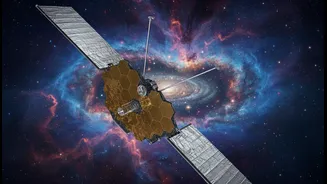
Even with the arrival of the more powerful James Webb Space Telescope (JWST), Hubble’s mission is not over. The two observatories are complementary partners. Hubble primarily observes in ultraviolet and visible light, while JWST is optimized for infrared. This allows them to study the cosmos in different ways; where Hubble sees star-forming dust clouds, Webb can peer inside them. Recent observations from July 2026 showcase Hubble's continued relevance, with the telescope capturing stunning new images of ancient star clusters and helping to identify light from an incredibly distant galaxy. By working in tandem with Webb, Hubble is still helping to answer fundamental questions, including how the early universe was cleared of the opaque fog that once filled it. Its data has contributed to over 19,000 scientific publications, making it one of the most productive scientific instruments ever built.