



An Increasingly Crowded Sky
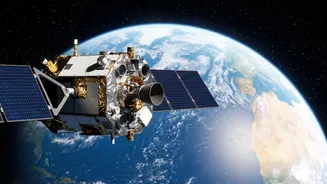
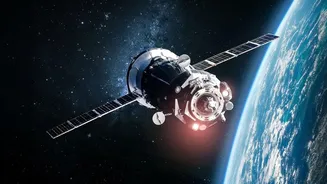
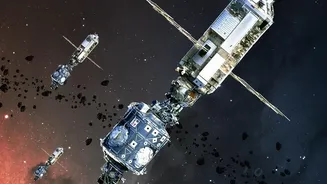
Low Earth Orbit (LEO) is becoming dangerously congested. It’s a cosmic junkyard of over 43,000 tracked objects larger than 10cm, including nearly 9,300 active satellites, defunct spacecraft, and spent rocket stages. Beyond what we can track, estimates
suggest there are over a million smaller fragments, each travelling at speeds exceeding 28,000 km/h. At that velocity, even a paint chip carries enough kinetic energy to cripple a multi-crore satellite. The risk is no longer theoretical. To safeguard its assets, the Indian Space Research Organisation (ISRO) performed a record 140 collision-avoidance manoeuvres (CAMs) in 2025 alone, a dramatic increase from just a handful a decade prior. This highlights a growing operational challenge for every space-faring nation.
The Current Method: A Manual Dodge
Currently, avoiding a collision in space is a tense, manual process. Under Project NETRA, ISRO's space situational awareness initiative, engineers on the ground constantly monitor for potential threats. When the probability of a collision with an Indian satellite crosses a critical threshold, a CAM is ordered. This involves firing the satellite's onboard chemical thrusters to alter its orbit slightly, moving it out of the path of the incoming debris. While effective, this method has significant drawbacks. Each manoeuvre consumes precious fuel, which directly shortens the operational lifespan of a satellite. Furthermore, it requires constant human oversight and can disrupt the satellite's primary functions, like communication or Earth observation services.
A New Brain: AI-Powered Vigilance
To overcome these limitations, ISRO is developing the 'brains' of a next-generation defence system: Artificial Intelligence. In collaboration with academic partners like the Indraprastha Institute of Information Technology (IIIT) in Delhi, ISRO is building an AI-driven Space Situational Awareness (SSA) platform. Unlike current systems that rely on human analysis, this AI is designed to automate the entire process, from processing vast amounts of tracking data to identifying threats with greater speed and accuracy. By learning from orbital patterns, the system aims to predict potential collisions far earlier, paving the way for a fully autonomous response without waiting for commands from Earth.
The New Muscle: Next-Generation Thrusters
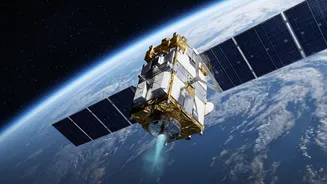
An autonomous brain needs an efficient muscle to act. This is where new propulsion technology comes in. ISRO has successfully tested advanced thrusters that are ideal for the small, precise orbital adjustments required for collision avoidance. On its innovative POEM-3 mission in early 2024, which turned a spent rocket stage into an orbital testbed, ISRO validated a Hall-effect thruster developed by Indian startup Bellatrix Aerospace. These electric propulsion systems use xenon gas and electromagnetic fields to generate thrust. They are far more fuel-efficient than traditional chemical thrusters, allowing a satellite to perform hundreds of avoidance manoeuvres over its lifetime with minimal impact on its primary mission duration.
Putting It Together: An Autonomous Shield
The combination of these two technologies—AI-driven threat assessment and efficient electric thrusters—is the future of satellite protection. The vision is an autonomous system where the AI on board a satellite detects an imminent collision and automatically fires the Hall thruster to gently nudge itself into a safer orbit. This 'AI thruster' concept removes the delay of ground control, provides near-instantaneous protection, and dramatically extends the life and value of India's assets in space. This capability is not just an upgrade; it is a fundamental requirement for sustainably operating large satellite constellations and complex missions in the increasingly hazardous space environment of the coming decade.