



The Solar System’s Grand Collector
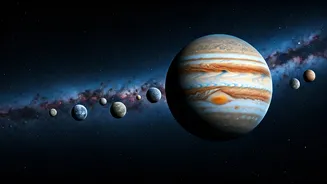
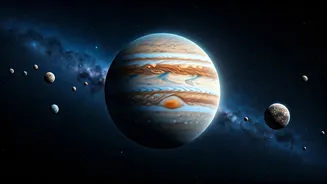
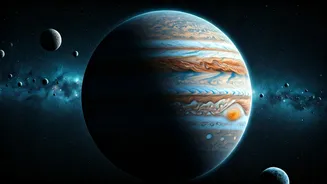
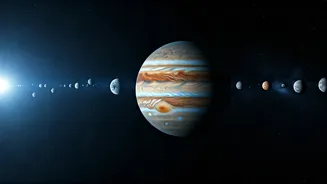
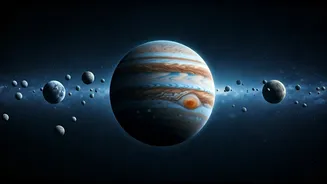
Jupiter's status as the king of the planets isn't just about its immense size; it's also about its extensive family of moons. As of early 2026, the official count of Jupiter's recognised moons has climbed past 100, a number that keeps astronomers busy
and stargazers in awe. [3, 5, 9] The headline number often varies depending on which discoveries have been officially confirmed, but one thing is certain: Jupiter is a grand collector of celestial objects. [9] While Saturn currently holds the record for the most moons, Jupiter’s total has been rapidly increasing as new discoveries are made. [5] This isn't just a numbers game; each new moon adds another piece to the puzzle of how our solar system formed and evolved. Most of these recently found moons are tiny, just a few kilometres across, and travel in distant, irregular orbits. [5, 12]
A Solar System in Miniature
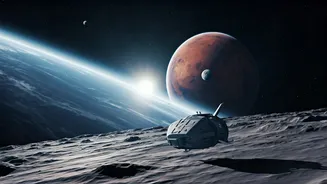
To understand Jupiter's moons, it helps to think of them not as a single group, but as multiple distinct systems. First, there are the four small inner moons, which are very close to the planet and are thought to be the source of its faint ring system. [2] Then come the stars of the show: the Galilean moons. Discovered by Galileo Galilei in 1610, Io, Europa, Ganymede, and Callisto were the first moons ever found orbiting another planet. [4, 6] Their discovery was a revolutionary moment in science, proving that not everything in the cosmos revolved around Earth. [4] These four are so large they would be considered planets or dwarf planets if they orbited the sun on their own. [2, 6] Ganymede is even larger than the planet Mercury. [7] Together, these four giants contain about 99.997% of the total mass orbiting Jupiter. [2]
The Wild Outer Moons
Beyond the stately orbits of the Galilean moons lies a chaotic swarm of over 100 smaller, irregular satellites. [2] These are thought to be captured asteroids or comet fragments that were snared by Jupiter's immense gravity. [12] Unlike the inner moons, which orbit in the same direction as Jupiter's rotation (prograde), many of these outer moons travel in the opposite direction (retrograde). [10] Astronomers believe these retrograde moons may be the remnants of larger bodies that shattered in collisions long ago. [10] Finding these tiny, distant objects is a monumental task. Astronomers like Scott Sheppard have discovered a majority of Jupiter's moons, often by using powerful ground-based telescopes to scan the skies near the planet. [5, 16] Sometimes, these discoveries are even made by accident while looking for something else entirely, like the theoretical Planet X. [13]
Worlds of Fire and Ice
The diversity of Jupiter’s moon systems is staggering. Io, the innermost Galilean moon, is the most volcanically active body in the solar system, its surface constantly repaved by lava. [7, 8] This incredible activity is caused by the immense gravitational push and pull from Jupiter and the other Galilean moons. [1] Next is Europa, whose smooth, icy shell is believed to cover a vast saltwater ocean containing more water than all of Earth's oceans combined. [7, 18] This makes it one of the most promising places in the solar system to search for life. [8] Ganymede, the largest moon, has its own magnetic field, and like Europa, is also thought to have a subsurface ocean. [7] Finally, Callisto is a heavily cratered world, its ancient surface a record of the solar system's violent history. [1, 7]
The Quest for More Answers
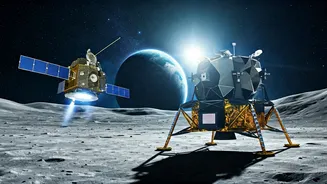
Our exploration of Jupiter's moon systems is far from over. NASA's Europa Clipper mission, which launched in 2024, is currently on its way to perform dozens of flybys of the icy moon, arriving in Jupiter's orbit in 2030. [15, 18] Its goal is to investigate whether Europa has the necessary conditions for life. [20] It will be joined in the Jovian system by the European Space Agency's JUICE (Jupiter Icy Moons Explorer) mission, which launched in 2023 and will arrive in 2031. [17, 19] JUICE will study Ganymede, Callisto, and Europa in detail before attempting to become the first spacecraft to orbit a moon in the outer solar system (Ganymede). [19] These missions, along with continued observations from Earth, promise to reveal even more secrets about the planet that holds a solar system of its own.