








The Familiar Problem of Urban Flooding
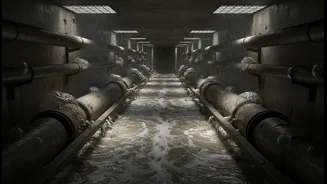
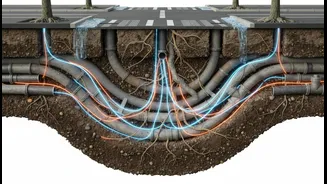
For residents of major Indian cities, the sight of waterlogged streets during monsoon season is all too common. Traditional urban planning has focused on managing surface water. The logic seems simple: rain falls on a city, hits impermeable surfaces like
concrete and asphalt, and is channelled into drainage systems. But as climate change fuels more extreme weather events, these systems are frequently overwhelmed. For decades, the primary culprits were considered to be the sheer volume of rainfall and the lack of green spaces to absorb it. While these factors are undeniably critical, new research suggests a crucial part of the equation has been missing from our calculations.
A Hidden Player Beneath Our Feet
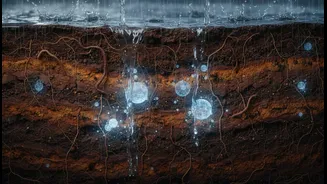
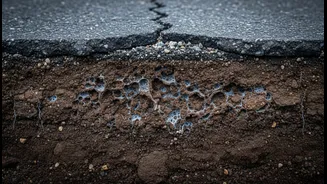
The ground beneath our feet is not a simple sponge. Soil is a porous mixture of solid particles, water, and, crucially, air. When rain begins to fall, it seeps into these pores, displacing the air. During light showers, this air can easily escape. However, during the intense downpours that are becoming more frequent, a large volume of water can hit the ground at once, effectively creating a seal over the soil surface. This process traps large pockets of air underground. Recent studies, including significant work from researchers at Princeton University, highlight that this trapped air doesn't just sit there passively; it actively resists the water trying to get in.
How Trapped Air Worsens Flooding
Imagine trying to force water into a bottle that's already full of air with no way for that air to escape. It's incredibly difficult. A similar phenomenon happens in the soil. The trapped, compressed air exerts an upward pressure that fights against the downward force of the infiltrating rainwater. This resistance dramatically slows down the rate at which the ground can absorb water. Some experiments have shown that air entrapment can reduce the soil's infiltration rate by a factor of three to ten. Consequently, water that should be soaking into the ground is instead forced to remain on the surface, where it pools and becomes runoff. This extra surface runoff places an even greater, and often unforeseen, burden on stormwater drains, contributing directly to more severe and rapid-onset flooding.
Why Current Models Fall Short
The models that city planners and hydrologists use to predict flood risk and design drainage infrastructure are incredibly complex. They account for topography, land use, rainfall intensity, and soil type. However, many of these models either completely ignore the effect of air entrapment or use a simplified assumption that the soil is fully saturated with water from the start. These models often overestimate how much water the ground can absorb and underestimate the amount of surface runoff that will be generated. This oversight can lead to the design of infrastructure that is inadequate for real-world conditions, leaving communities vulnerable to flooding even when they believe they are prepared.
The Future of Urban Flood Prediction
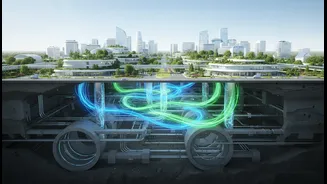
The growing recognition of air entrapment's role is pushing for a new generation of urban flood models. By incorporating the physics of two-phase flow—water and air—planners can create far more accurate predictions. This could lead to smarter infrastructure design. For example, knowing which soil types are most prone to air entrapment could guide the placement of green infrastructure like permeable pavements and rain gardens, which are designed to maximize water absorption. It would allow for better-calibrated early warning systems and more realistic flood maps that identify at-risk areas with greater precision. Accounting for the air beneath our cities is a critical step toward building more resilient urban environments capable of weathering the storms of the future.